Conduit Fill Calculator
A conduit fill calculator checks how many wires fit in a conduit under the National Electrical Code. Pick the conduit type and size, add each conductor by gauge and count, and see the fill percentage against the 53, 31 or 40 percent limit. It also finds the smallest conduit that works.
- Wires
- 0
- Total wire area
- 0
- Fill limit (Table 1)
- –
- Allowed area
- –
- Your fill
- –
- Smallest size that fits
- –
| Size | Allowed (sq in) | Fill |
|---|
All drawers
Each page opens with its own calculator or chart, then adds the method and source tables.
Shop and auto
How conduit fill is calculated
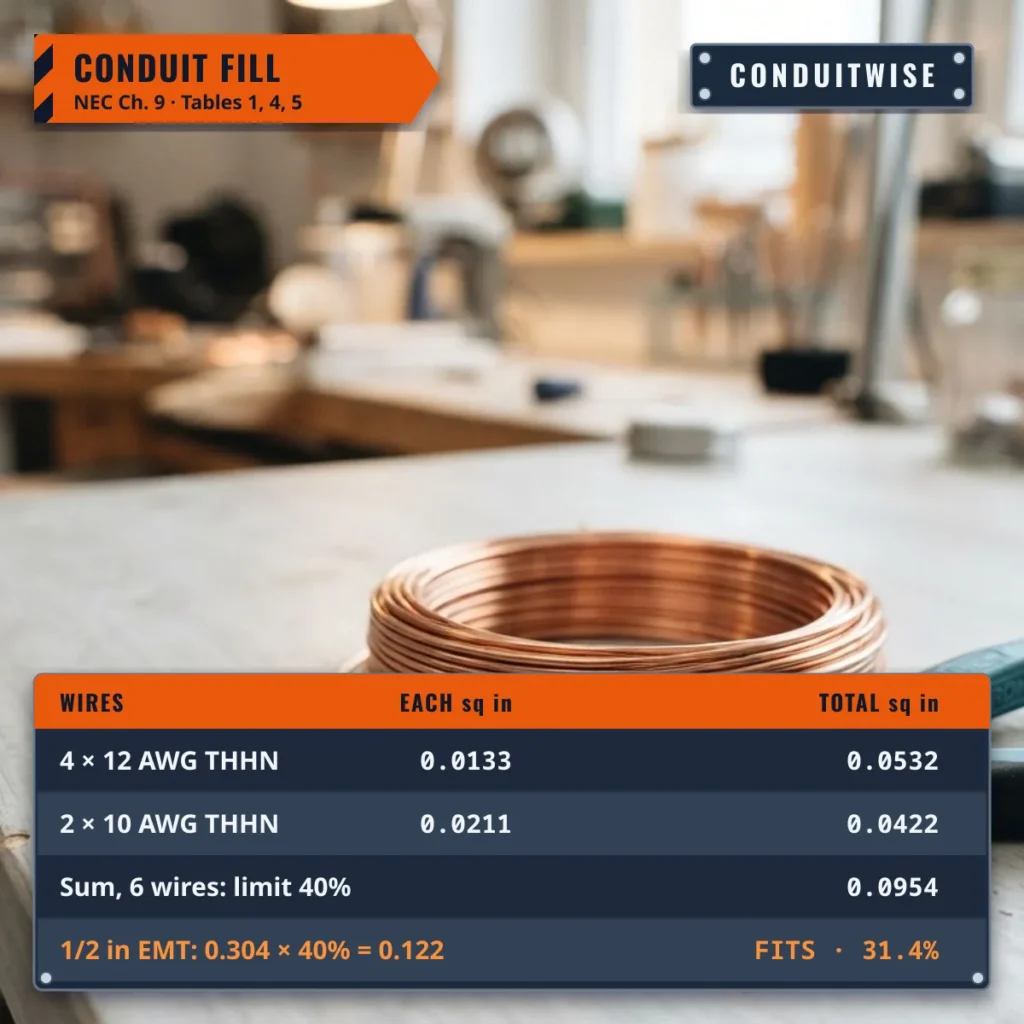
The NEC does not let you fill a conduit completely. Wires need room so they can be pulled in and so heat can escape. Chapter 9, Table 1 sets the maximum share of the conduit’s inside area that the wires may occupy, and Tables 4 and 5 give the areas to use.
- Look up each conductor’s area in Table 5 and multiply by how many you have.
- Add the areas to get the total wire area.
- Choose the fill limit from Table 1: 53% for one wire, 31% for two, 40% for more than two.
- Find the conduit whose Table 4 area at that percentage is at least the total wire area.
Worked examples
| Wires | Total area | Limit | Result |
|---|---|---|---|
| 4 × 12 AWG + 2 × 10 AWG | 4 × 0.0133 + 2 × 0.0211 = 0.0954 sq in | 40% (6 wires) | 1/2 in EMT allows 0.122, so it fits at 31.4% |
| 3 × 4 AWG + 1 × 8 AWG | 3 × 0.0824 + 0.0366 = 0.2838 sq in | 40% (4 wires) | 3/4 in EMT allows 0.213, too small. 1 in EMT allows 0.346, so use 1 in (32.8%) |
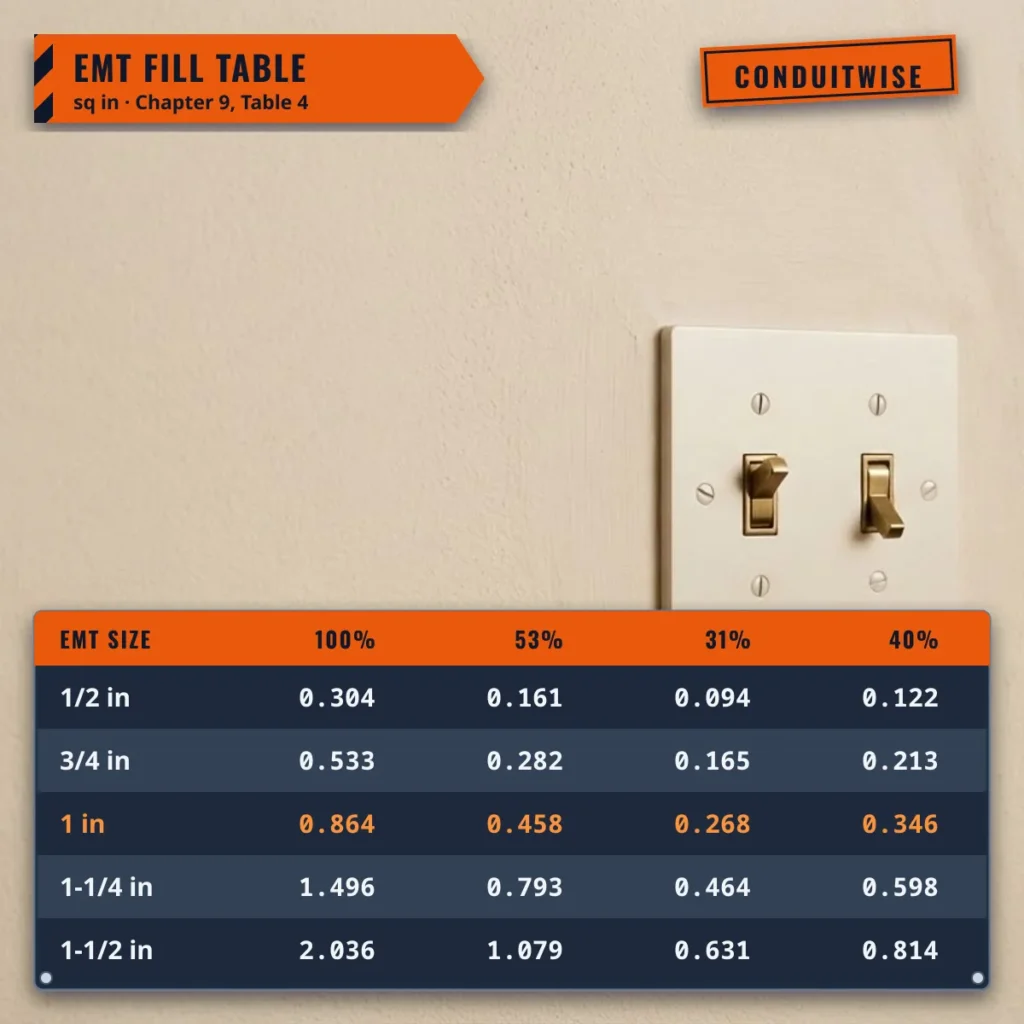
EMT internal area (Table 4)
| Trade size | 100% (sq in) | 53% | 31% | 40% |
|---|---|---|---|---|
| 1/2 in | 0.304 | 0.161 | 0.094 | 0.122 |
| 3/4 in | 0.533 | 0.282 | 0.165 | 0.213 |
| 1 in | 0.864 | 0.458 | 0.268 | 0.346 |
| 1-1/4 in | 1.496 | 0.793 | 0.464 | 0.598 |
| 1-1/2 in | 2.036 | 1.079 | 0.631 | 0.814 |
| 2 in | 3.356 | 1.779 | 1.040 | 1.342 |
| 2-1/2 in | 5.858 | 3.105 | 1.816 | 2.343 |
| 3 in | 8.846 | 4.688 | 2.742 | 3.538 |
| 3-1/2 in | 11.545 | 6.119 | 3.579 | 4.618 |
| 4 in | 14.753 | 7.819 | 4.573 | 5.901 |
THHN / THWN conductor area (Table 5)
| Size | Area (sq in) |
|---|---|
| 14 AWG | 0.0097 |
| 12 AWG | 0.0133 |
| 10 AWG | 0.0211 |
| 8 AWG | 0.0366 |
| 6 AWG | 0.0507 |
| 4 AWG | 0.0824 |
| 3 AWG | 0.0973 |
| 2 AWG | 0.1158 |
| 1 AWG | 0.1562 |
| 1/0 AWG | 0.1855 |
| 2/0 AWG | 0.2223 |
| 3/0 AWG | 0.2679 |
| 4/0 AWG | 0.3237 |
| 250 kcmil | 0.3970 |
| 300 kcmil | 0.4608 |
| 350 kcmil | 0.5242 |
| 400 kcmil | 0.5863 |
| 500 kcmil | 0.7073 |
How we checked the calculator
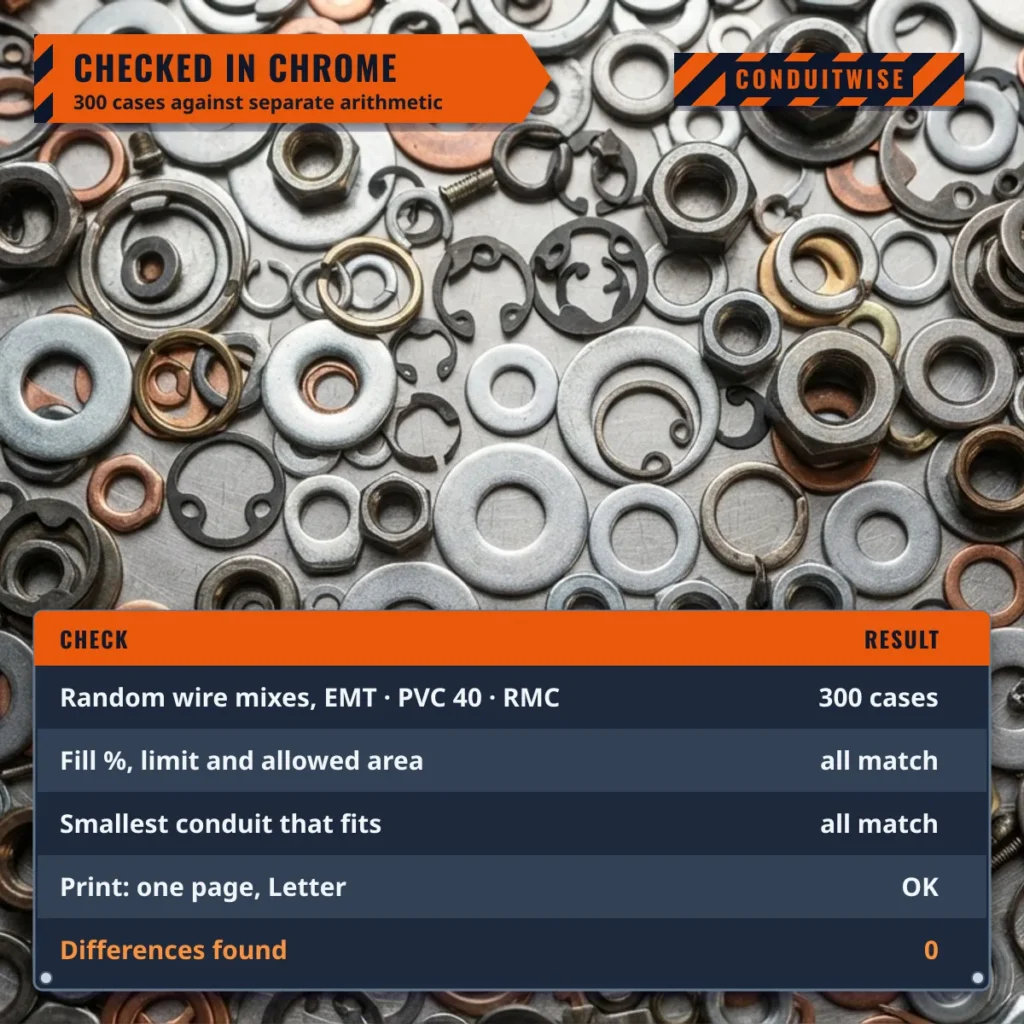
We typed the three tables in a second time, made 300 random wire mixes in EMT, PVC Schedule 40 and rigid metal conduit, entered each in Chrome and compared the wire count, limit, allowed area, fill and smallest size that fits: 0 differences. The result prints on one Letter page.
Tips
- Count every conductor, including grounds and neutrals that carry current.
- Leave extra room for long runs or many bends, where pulling is harder, even if the table says it fits.
- Mixed insulation types need their own Table 5 values.
- Conduit fill is not ampacity. Many wires in one conduit may need derating, which is a separate calculation.
Frequently asked questions
What fill percentages does the NEC allow?
NEC Chapter 9, Table 1 allows 53 percent of the conduit’s cross-section for one conductor, 31 percent for two and 40 percent for more than two. The calculator picks the limit from the total number of conductors you enter.
Do I count the ground wire?
Yes. Equipment grounding and bonding conductors count toward the number of conductors and toward the area. Add them as separate rows.
Why are only THHN and THWN wires listed?
Table 5 gives a different area for each insulation type. This calculator uses the values for THHN, THWN and THWN-2, which are the most common building wires. Other insulation types need their own Table 5 values.
Does the same wire fit the same in every conduit type?
No. EMT, rigid metal conduit and PVC Schedule 40 have different internal diameters, so Table 4 gives each its own area. Switch the conduit type to compare.
What about short nipples?
Chapter 9, Table 1, Note 4 permits a 60 percent fill for conduit and tubing nipples that are not longer than 24 inches. This calculator uses the standard limits and does not apply that exception.
Is this a substitute for the code or an electrician?
No. It is a planning tool. Always confirm values against the NEC edition adopted where you work, follow local amendments and use a licensed electrician for installations.
Did this tool pass inspection?
Mark it as passed, or send it back for rework with a note.
Logged. Thank you for the report.