Actual Size Wire Gauge Chart
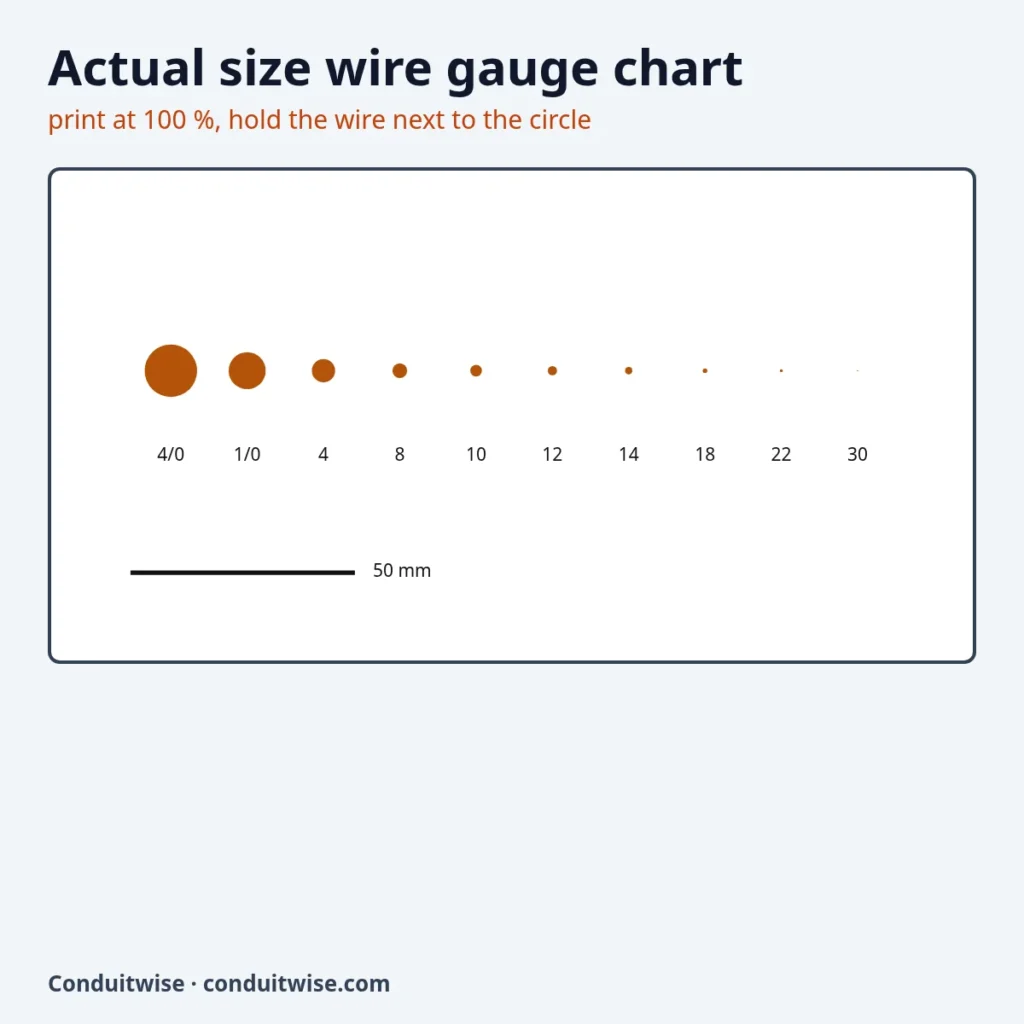
An actual size wire gauge chart shows copper wire sizes as true-size circles, so you can hold a wire against the page and read its gauge. It runs from 4/0 to 40 AWG, with a 50 mm scale bar to check your printer. Measure your wire in the tool to find the nearest gauge.
- You measured
- 1.600 mm · 0.0630 in
- Nearest gauge
- 14 AWG
- That gauge is
- 1.628 mm · 0.0641 in
- Difference
- 0.028 mm
- Copper area
- 2.081 mm²
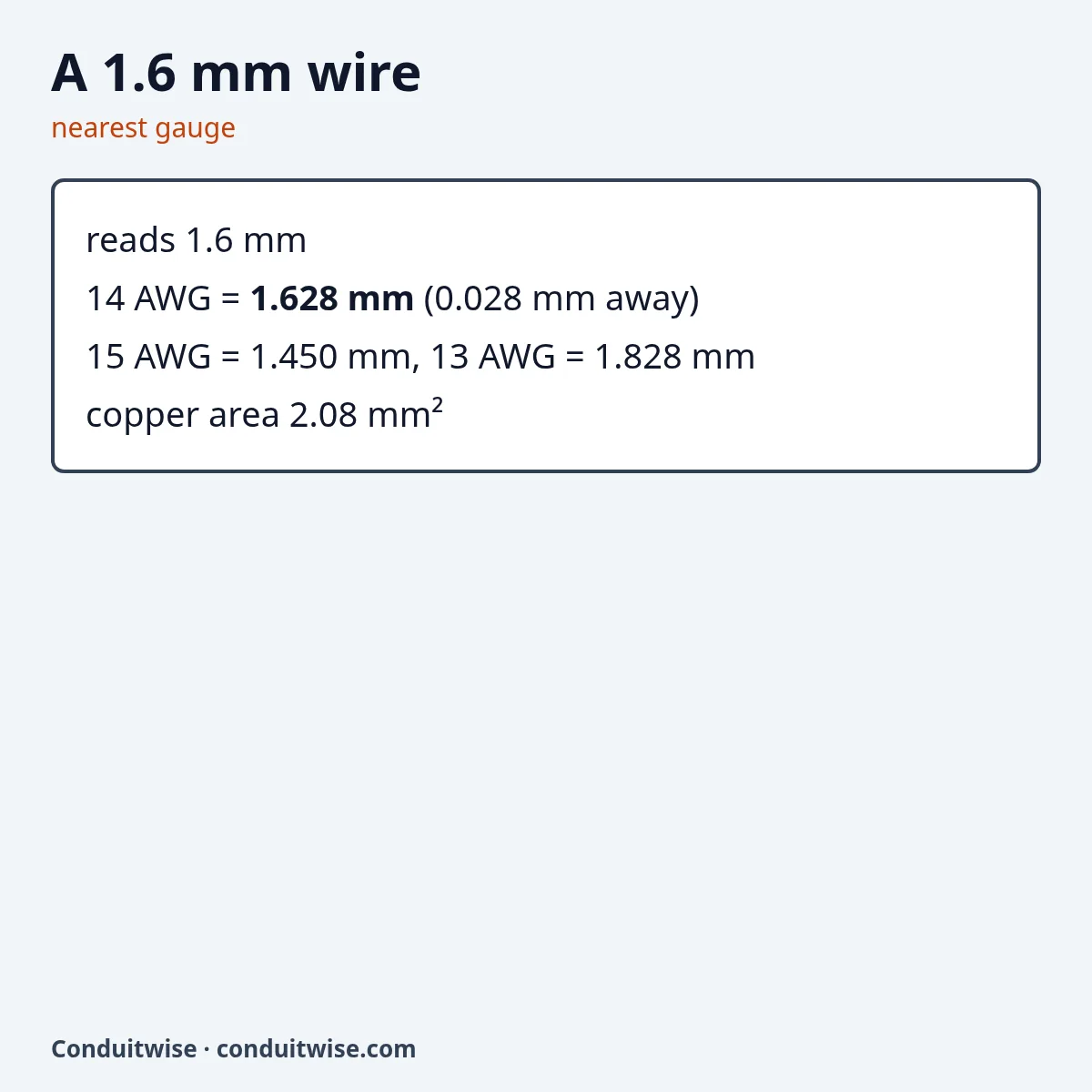
Measure the bare copper with calipers, not the insulation. Stranded wire reads slightly larger than solid wire of the same gauge.
Worked example: a 1.6 mm wire
A wire that reads 1.6 mm across is closest to 14 AWG, which is 1.628 mm, 0.028 mm away. The next gauge up, 15 AWG, is 1.450 mm and the next down, 13 AWG, is 1.828 mm, so 14 AWG is the closest. Its copper area is π ÷ 4 × 1.628² = 2.08 mm².
How to print it at true size
- Press Print at 100 % and choose US Letter or A4 with the scale at 100 percent, not Fit to page.
- Measure the 50 mm bar with a ruler. If it is not 50 mm, change the print scale.
- Hold the stripped wire next to the circles.
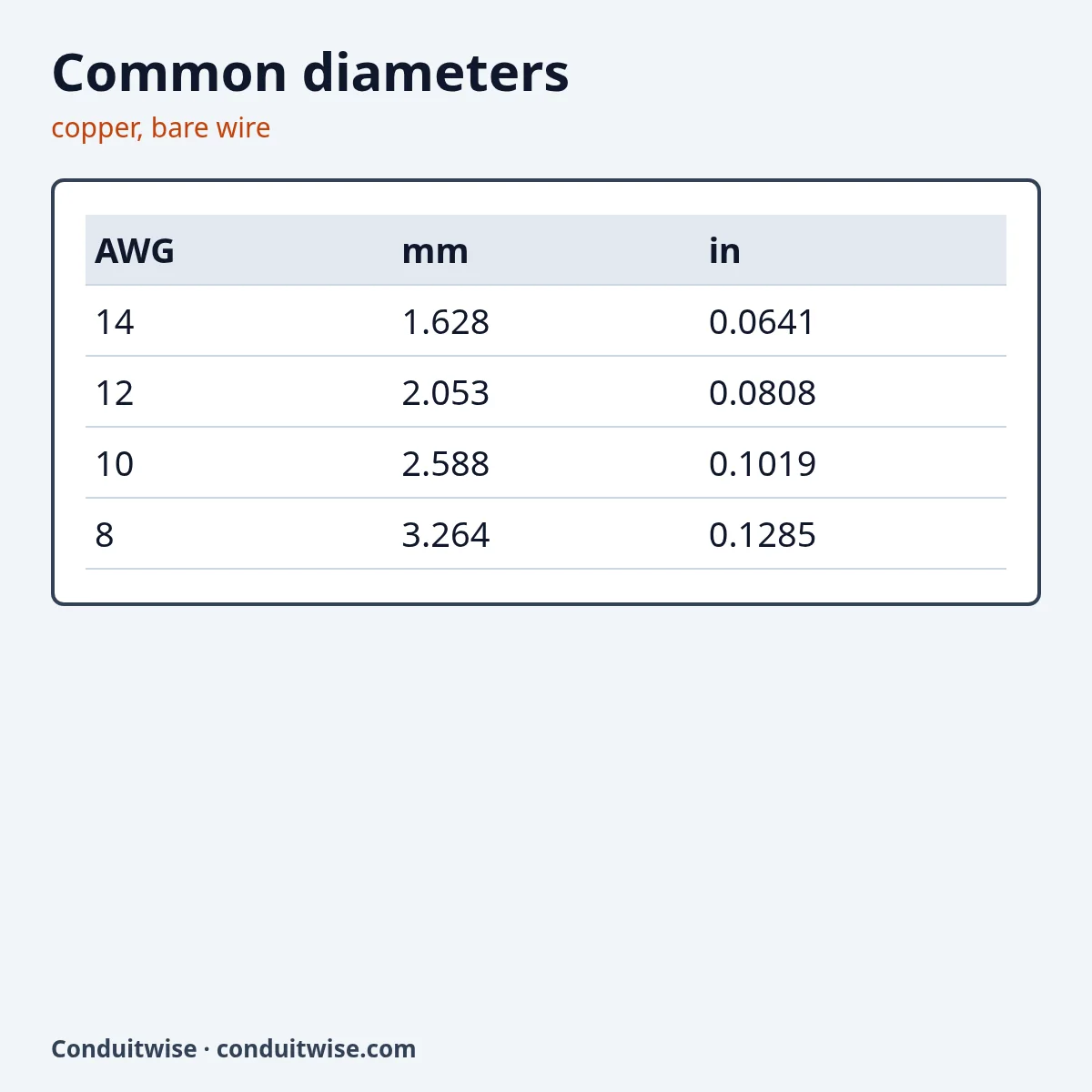
Wire gauge diameters
| AWG | Diameter (mm) | Diameter (in) | Area (mm²) |
|---|---|---|---|
| 4/0 | 11.684 | 0.4600 | 107.219 |
| 3/0 | 10.405 | 0.4096 | 85.029 |
| 2/0 | 9.266 | 0.3648 | 67.431 |
| 1/0 | 8.251 | 0.3249 | 53.475 |
| 1 | 7.348 | 0.2893 | 42.408 |
| 2 | 6.544 | 0.2576 | 33.631 |
| 3 | 5.827 | 0.2294 | 26.670 |
| 4 | 5.189 | 0.2043 | 21.151 |
| 5 | 4.621 | 0.1819 | 16.773 |
| 6 | 4.115 | 0.1620 | 13.302 |
| 7 | 3.665 | 0.1443 | 10.549 |
| 8 | 3.264 | 0.1285 | 8.366 |
| 9 | 2.906 | 0.1144 | 6.634 |
| 10 | 2.588 | 0.1019 | 5.261 |
| 11 | 2.305 | 0.0907 | 4.172 |
| 12 | 2.053 | 0.0808 | 3.309 |
| 13 | 1.828 | 0.0720 | 2.624 |
| 14 | 1.628 | 0.0641 | 2.081 |
| 15 | 1.450 | 0.0571 | 1.650 |
| 16 | 1.291 | 0.0508 | 1.309 |
| 17 | 1.150 | 0.0453 | 1.038 |
| 18 | 1.024 | 0.0403 | 0.823 |
| 19 | 0.912 | 0.0359 | 0.653 |
| 20 | 0.812 | 0.0320 | 0.518 |
| 21 | 0.723 | 0.0285 | 0.410 |
| 22 | 0.644 | 0.0253 | 0.326 |
| 23 | 0.573 | 0.0226 | 0.258 |
| 24 | 0.511 | 0.0201 | 0.205 |
| 25 | 0.455 | 0.0179 | 0.162 |
| 26 | 0.405 | 0.0159 | 0.129 |
| 27 | 0.361 | 0.0142 | 0.102 |
| 28 | 0.321 | 0.0126 | 0.081 |
| 29 | 0.286 | 0.0113 | 0.064 |
| 30 | 0.255 | 0.0100 | 0.051 |
| 31 | 0.227 | 0.0089 | 0.040 |
| 32 | 0.202 | 0.0080 | 0.032 |
| 33 | 0.180 | 0.0071 | 0.025 |
| 34 | 0.160 | 0.0063 | 0.020 |
| 35 | 0.143 | 0.0056 | 0.016 |
| 36 | 0.127 | 0.0050 | 0.013 |
| 37 | 0.113 | 0.0045 | 0.010 |
| 38 | 0.101 | 0.0040 | 0.008 |
| 39 | 0.090 | 0.0035 | 0.006 |
| 40 | 0.080 | 0.0031 | 0.005 |
Limits
On a screen the circles are only as true as the screen’s pixel size, so print the page before you compare a wire. The diameters follow the AWG formula d = 0.005 in × 92^((36 − n) ÷ 39). See the disclaimer.
How we checked it
On 22 October 2026 we compared the page’s calculation with a separate Python calculation on 250 random cases: no differences. The diameters for 4/0, 10, 12, 14, 18, 22, 30 and 40 AWG agree with the published values. We also printed the page to PDF in Chrome on A4 and on US Letter: the chart fits on one page, and the drawing stays 190 mm wide, so the 50 mm bar is 50 mm.
Frequently asked questions
How do I use an actual size wire gauge chart?
Print the page at 100 percent, check that the scale bar measures 50 mm, then hold the bare copper next to the circles. Use the tool to enter a caliper reading.
What size is 14 AWG wire?
14 AWG is 1.628 mm (0.0641 in) across and has 2.08 mm² of copper.
Does the insulation count in the size?
No. The gauge is the diameter of the bare copper. Measure with the insulation stripped.
Why do stranded and solid wires differ?
Stranded wire of the same gauge reads a little larger because of gaps between the strands, so it is a rough guide.
See also the electrical gauge wire chart and the speaker wire gauge chart.
Did this tool pass inspection?
Mark it as passed, or send it back for rework with a note.
Logged. Thank you for the report.