Wire gauge chart (AWG)
Find any AWG size’s diameter, cross-section and resistance, with copper and aluminium side by side. Need the amp rating rather than the size? Use the ampacity chart, or see the conduit fill tool for conduit sizing.
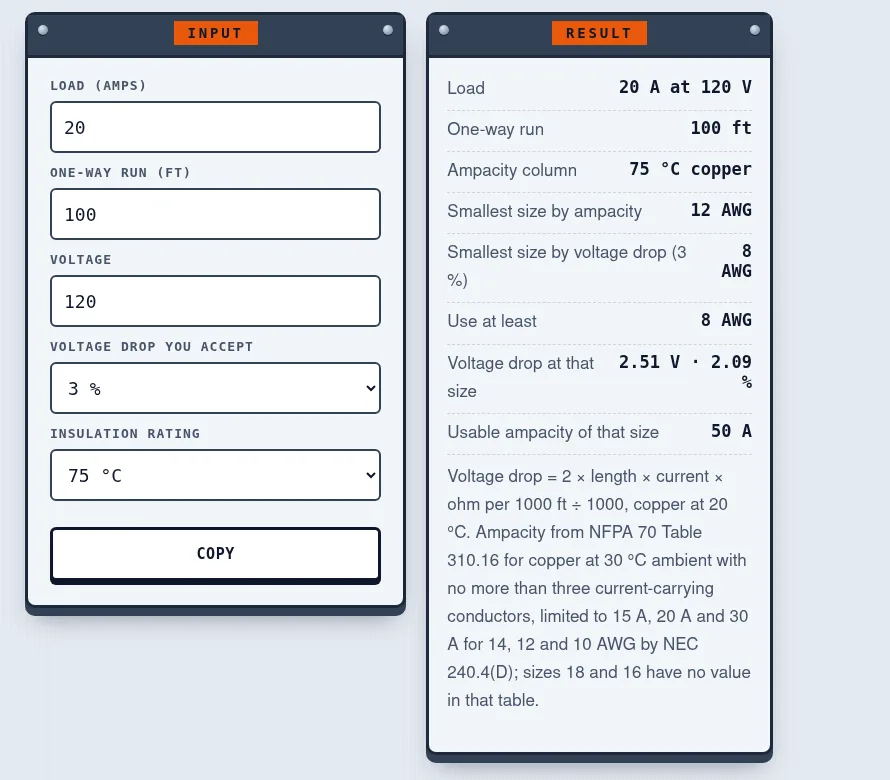
- Load
- 20 A at 120 V
- One-way run
- 100 ft
- Ampacity column
- 75 °C copper
- Smallest size by ampacity
- 12 AWG
- Smallest size by voltage drop (3 %)
- 8 AWG
- Use at least
- 8 AWG
- Voltage drop at that size
- 2.51 V · 2.09 %
- Usable ampacity of that size
- 50 A
Voltage drop = 2 × length × current × ohm per 1000 ft ÷ 1000, copper at 20 °C. Ampacity from NFPA 70 Table 310.16 for copper at 30 °C ambient with no more than three current-carrying conductors, limited to 15 A, 20 A and 30 A for 14, 12 and 10 AWG by NEC 240.4(D); sizes 18 and 16 have no value in that table.
AWG sizes with diameter and resistance
Measure the bare conductor with calipers and match the diameter in the chart; 12 AWG solid is about 0.081 inch, 14 AWG about 0.064. On cable, the gauge is usually printed on the jacket. Stranded wire is slightly larger than solid of the same gauge.
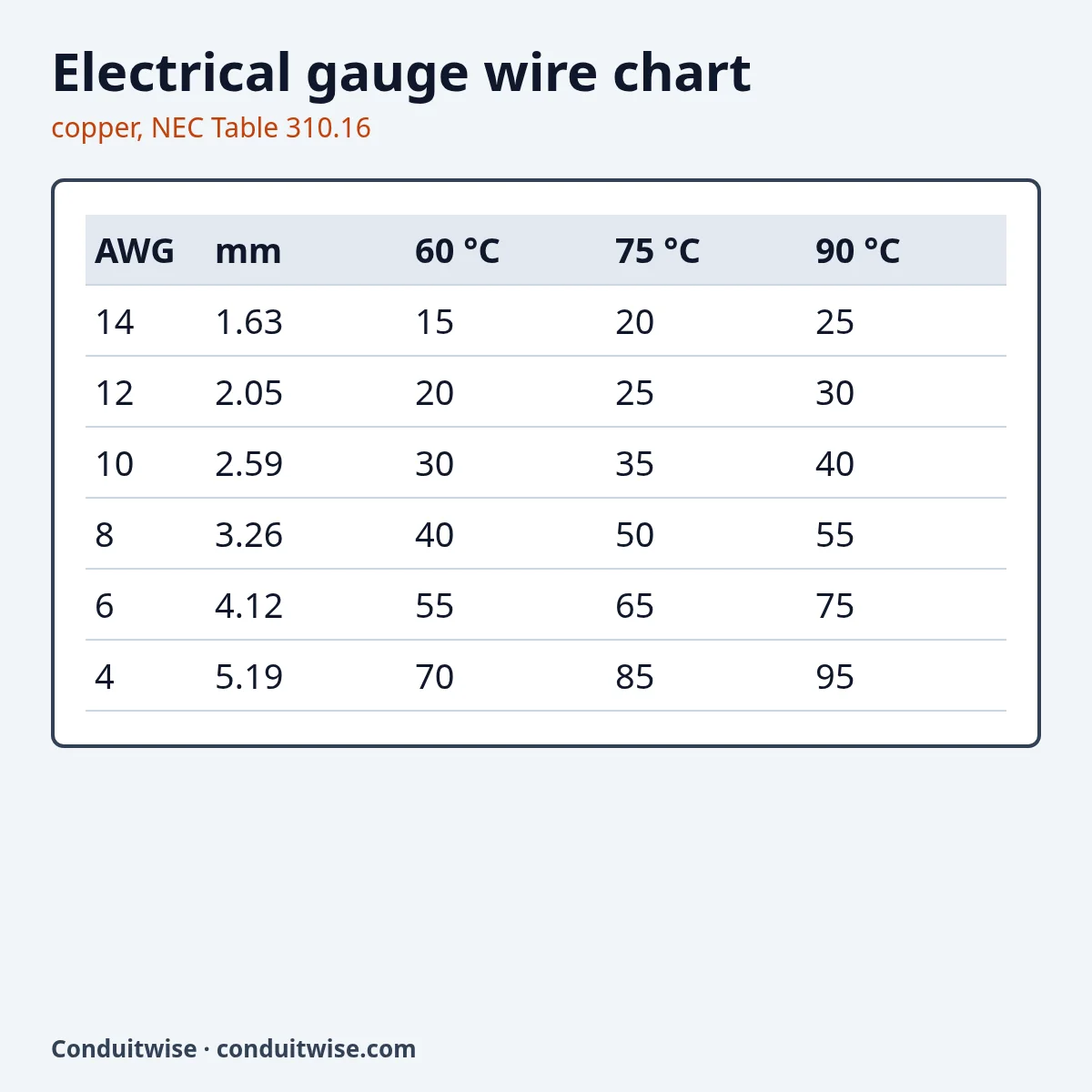
Resistance turns the size into a voltage drop. For a two-wire circuit, drop = 2 × length × current × ohm per 1000 ft ÷ 1000. At 20 A over 100 ft, 12 AWG (1.588 ohm per 1000 ft) drops 6.35 V, while 8 AWG (0.628 ohm per 1000 ft) drops 2.51 V, which is 2.09 % of 120 V.
Full AWG reference table
The table lists every AWG size from 4/0 down to 30 with diameter, area and DC resistance for copper and aluminium. Values follow the AWG formula (ASTM B258) at 20 °C, with copper at 1.724 µΩ·cm and 1350 aluminium at 2.82 µΩ·cm, so you can compute voltage drop or compare with metric cable. NEC Chapter 9 Table 8 prints DC resistance at 75 °C, which is higher.
| AWG | Diameter (in) | Diameter (mm) | Area (kcmil) | Area (mm²) | Copper (ohm per 1000 ft) | Aluminium (ohm per 1000 ft) |
|---|---|---|---|---|---|---|
| 4/0 | 0.4600 | 11.684 | 211.6 | 107.22 | 0.049 | 0.080 |
| 3/0 | 0.4096 | 10.405 | 167.8 | 85.03 | 0.062 | 0.101 |
| 2/0 | 0.3648 | 9.266 | 133.1 | 67.43 | 0.078 | 0.127 |
| 1/0 | 0.3249 | 8.251 | 105.5 | 53.48 | 0.098 | 0.161 |
| 1 | 0.2893 | 7.348 | 83.7 | 42.41 | 0.124 | 0.203 |
| 2 | 0.2576 | 6.544 | 66.4 | 33.63 | 0.156 | 0.256 |
| 3 | 0.2294 | 5.827 | 52.6 | 26.67 | 0.197 | 0.322 |
| 4 | 0.2043 | 5.189 | 41.7 | 21.15 | 0.248 | 0.406 |
| 5 | 0.1819 | 4.621 | 33.1 | 16.77 | 0.313 | 0.512 |
| 6 | 0.1620 | 4.115 | 26.3 | 13.30 | 0.395 | 0.646 |
| 7 | 0.1443 | 3.665 | 20.8 | 10.55 | 0.498 | 0.815 |
| 8 | 0.1285 | 3.264 | 16.5 | 8.37 | 0.628 | 1.028 |
| 9 | 0.1144 | 2.906 | 13.1 | 6.63 | 0.792 | 1.296 |
| 10 | 0.1019 | 2.588 | 10.4 | 5.26 | 0.999 | 1.634 |
| 11 | 0.0907 | 2.305 | 8.2 | 4.17 | 1.260 | 2.060 |
| 12 | 0.0808 | 2.053 | 6.5 | 3.31 | 1.588 | 2.598 |
| 13 | 0.0720 | 1.828 | 5.2 | 2.62 | 2.003 | 3.276 |
| 14 | 0.0641 | 1.628 | 4.1 | 2.08 | 2.525 | 4.131 |
| 15 | 0.0571 | 1.450 | 3.3 | 1.65 | 3.184 | 5.209 |
| 16 | 0.0508 | 1.291 | 2.6 | 1.31 | 4.015 | 6.568 |
| 17 | 0.0453 | 1.150 | 2.0 | 1.04 | 5.063 | 8.282 |
| 18 | 0.0403 | 1.024 | 1.6 | 0.82 | 6.385 | 10.444 |
| 19 | 0.0359 | 0.912 | 1.3 | 0.65 | 8.051 | 13.170 |
| 20 | 0.0320 | 0.812 | 1.0 | 0.52 | 10.152 | 16.607 |
| 21 | 0.0285 | 0.723 | 0.8 | 0.41 | 12.802 | 20.940 |
| 22 | 0.0253 | 0.644 | 0.6 | 0.33 | 16.143 | 26.405 |
| 23 | 0.0226 | 0.573 | 0.5 | 0.26 | 20.356 | 33.297 |
| 24 | 0.0201 | 0.511 | 0.4 | 0.20 | 25.668 | 41.986 |
| 25 | 0.0179 | 0.455 | 0.3 | 0.16 | 32.367 | 52.944 |
| 26 | 0.0159 | 0.405 | 0.3 | 0.13 | 40.814 | 66.761 |
| 27 | 0.0142 | 0.361 | 0.2 | 0.10 | 51.466 | 84.184 |
| 28 | 0.0126 | 0.321 | 0.2 | 0.08 | 64.897 | 106.154 |
| 29 | 0.0113 | 0.286 | 0.1 | 0.06 | 81.834 | 133.858 |
| 30 | 0.0100 | 0.255 | 0.1 | 0.05 | 103.190 | 168.791 |
Which is thicker, 12 or 14 gauge
In AWG a smaller number means a thicker wire, so 12 is thicker than 14, 16 or 20. Every drop of three gauge numbers roughly doubles the cross-section. That is why 12 AWG can carry more current than 14 AWG on the same circuit.
In the table, 14 AWG has 2.08 mm² and 12 AWG has 3.31 mm², about 1.6 times as much copper. For what each size may carry, see the ampacity chart. The page does not replace a licensed electrician or your local code; local amendments and inspectors have the final say.
More about the site is on the about conduitwise page.
Did this tool pass inspection?
Mark it as passed, or send it back for rework with a note.
Logged. Thank you for the report.