Ampacity Wire Gauge Chart
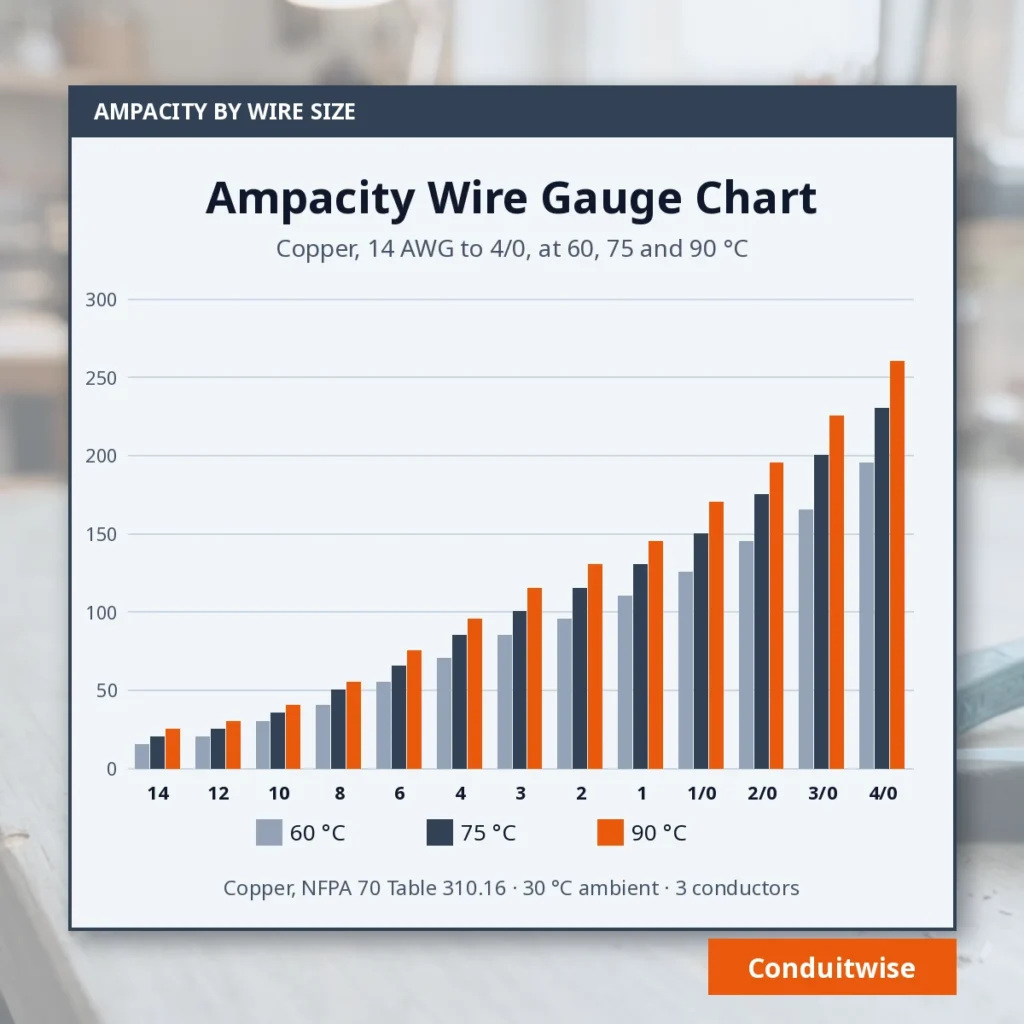
An ampacity wire gauge chart lists how many amps each wire size can carry. Pick copper or aluminum, the insulation rating, the ambient temperature and the number of conductors, and the tool gives the smallest size for your load. Table values come from NFPA 70 Table 310.16.
- Smallest size
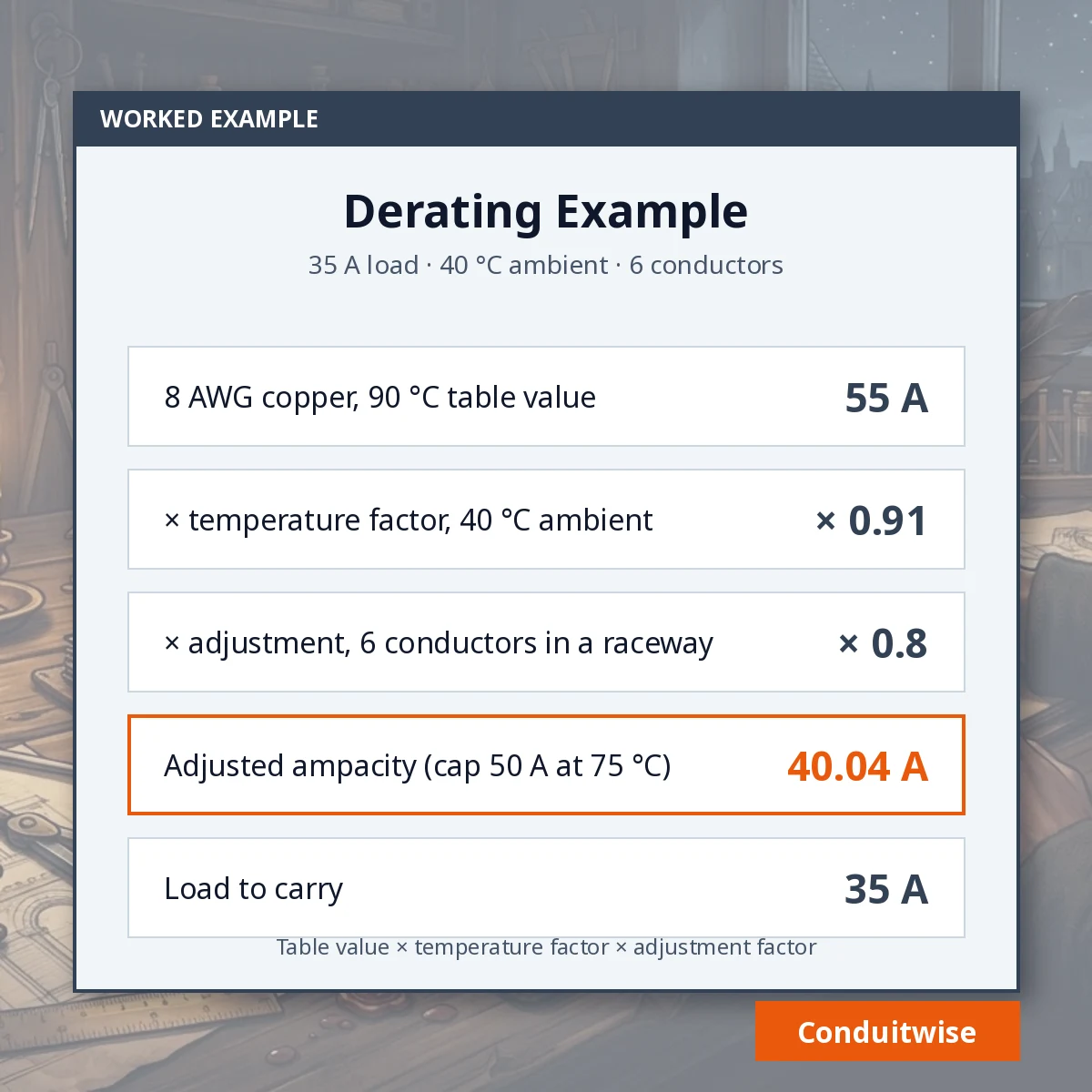
- 8 AWG copper
- Table ampacity
- 55 A (90 °C)
- Temperature factor
- 0.91
- Adjustment factor
- 0.8
- Adjusted ampacity
- 40.04 A
Adjusted = 55 × 0.91 × 0.8 = 40.04 A, never more than the 50 A allowed by the 75 °C terminals. Check local code and hire a licensed electrician.
| Size | Table (A) | Adjusted (A) | Terminal cap (A) | Usable (A) |
|---|
Worked example: 35 A load, 40 °C, six conductors
THHN copper wire (90 °C) runs in one conduit with six current-carrying conductors in a 40 °C space, ending on 75 °C terminals, and the load is 35 A. For 8 AWG the 90 °C table value is 55 A. The 40 °C ambient factor for the 90 °C column is 0.91 and six conductors call for 80 percent, so 55 × 0.91 × 0.8 = 40.04 A. The 75 °C terminals allow 50 A, so 40.04 A stands, and it is at least 35 A. 10 AWG gives 40 × 0.91 × 0.8 = 29.12 A, which is too small. The answer is 8 AWG.
Ampacity chart: copper
| Size | 60 °C (A) | 75 °C (A) | 90 °C (A) |
|---|---|---|---|
| 14 AWG | 15 | 20 | 25 |
| 12 AWG | 20 | 25 | 30 |
| 10 AWG | 30 | 35 | 40 |
| 8 AWG | 40 | 50 | 55 |
| 6 AWG | 55 | 65 | 75 |
| 4 AWG | 70 | 85 | 95 |
| 3 AWG | 85 | 100 | 115 |
| 2 AWG | 95 | 115 | 130 |
| 1 AWG | 110 | 130 | 145 |
| 1/0 AWG | 125 | 150 | 170 |
| 2/0 AWG | 145 | 175 | 195 |
| 3/0 AWG | 165 | 200 | 225 |
| 4/0 AWG | 195 | 230 | 260 |
| 250 kcmil | 215 | 255 | 290 |
| 300 kcmil | 240 | 285 | 320 |
| 350 kcmil | 260 | 310 | 350 |
| 400 kcmil | 280 | 335 | 380 |
| 500 kcmil | 320 | 380 | 430 |
Ampacity chart: aluminum and copper-clad aluminum
| Size | 60 °C (A) | 75 °C (A) | 90 °C (A) |
|---|---|---|---|
| 12 AWG | 15 | 20 | 25 |
| 10 AWG | 25 | 30 | 35 |
| 8 AWG | 30 | 40 | 45 |
| 6 AWG | 40 | 50 | 55 |
| 4 AWG | 55 | 65 | 75 |
| 3 AWG | 65 | 75 | 85 |
| 2 AWG | 75 | 90 | 100 |
| 1 AWG | 85 | 100 | 115 |
| 1/0 AWG | 100 | 120 | 135 |
| 2/0 AWG | 115 | 135 | 150 |
| 3/0 AWG | 130 | 155 | 175 |
| 4/0 AWG | 150 | 180 | 205 |
| 250 kcmil | 170 | 205 | 230 |
| 300 kcmil | 195 | 230 | 260 |
| 350 kcmil | 210 | 250 | 280 |
| 400 kcmil | 225 | 270 | 305 |
| 500 kcmil | 260 | 310 | 350 |
Ambient temperature correction
The table above assumes a 30 °C ambient. At other temperatures multiply the ampacity by these factors. A dash means that insulation rating is not allowed at that temperature.
| Ambient | 60 °C | 75 °C | 90 °C |
|---|---|---|---|
| 10 °C or less | 1.29 | 1.2 | 1.15 |
| 11–15 °C | 1.22 | 1.15 | 1.12 |
| 16–20 °C | 1.15 | 1.11 | 1.08 |
| 21–25 °C | 1.08 | 1.05 | 1.04 |
| 26–30 °C | 1.00 | 1.00 | 1.00 |
| 31–35 °C | 0.91 | 0.94 | 0.96 |
| 36–40 °C | 0.82 | 0.88 | 0.91 |
| 41–45 °C | 0.71 | 0.82 | 0.87 |
| 46–50 °C | 0.58 | 0.75 | 0.82 |
| 51–55 °C | 0.41 | 0.67 | 0.76 |
| 56–60 °C | — | 0.58 | 0.71 |
| 61–65 °C | — | 0.47 | 0.65 |
| 66–70 °C | — | 0.33 | 0.58 |
Adjustment for more than three conductors
When more than three current-carrying conductors share a raceway or cable, multiply by the percentage below.
| Current-carrying conductors | Multiply by |
|---|---|
| 1–3 | 100 % |
| 4–6 | 80 % |
| 7–9 | 70 % |
| 10–20 | 50 % |
| 21–30 | 45 % |
| 31–40 | 40 % |
| 41 and over | 35 % |
About these numbers
The values follow NFPA 70, the National Electrical Code, Table 310.16 (formerly 310.15(B)(16)), Table 310.15(B)(1) and Table 310.15(C)(1), as numbered in the 2023 edition. We have not checked them against the licensed text of every edition on this site, so confirm with your own copy of the code and your local amendments. Small copper conductors are also limited by overcurrent protection rules: 14 AWG to 15 A, 12 AWG to 20 A and 10 AWG to 30 A. Follow local code and hire a licensed electrician; this page is not a substitute for a design.
Frequently asked questions
What is ampacity?
Ampacity is the largest current, in amps, that a wire can carry continuously without its insulation getting hotter than its rating. It depends on the wire size, the metal, the insulation temperature rating and the conditions around the wire.
What is the ampacity of 12 AWG copper wire?
In the NEC table, 12 AWG copper is 20 A at 60 °C, 25 A at 75 °C and 30 A at 90 °C. The code also limits overcurrent protection for 12 AWG copper to 20 A, so the usable figure for ordinary circuits is 20 A.
Why is aluminum rated lower than copper?
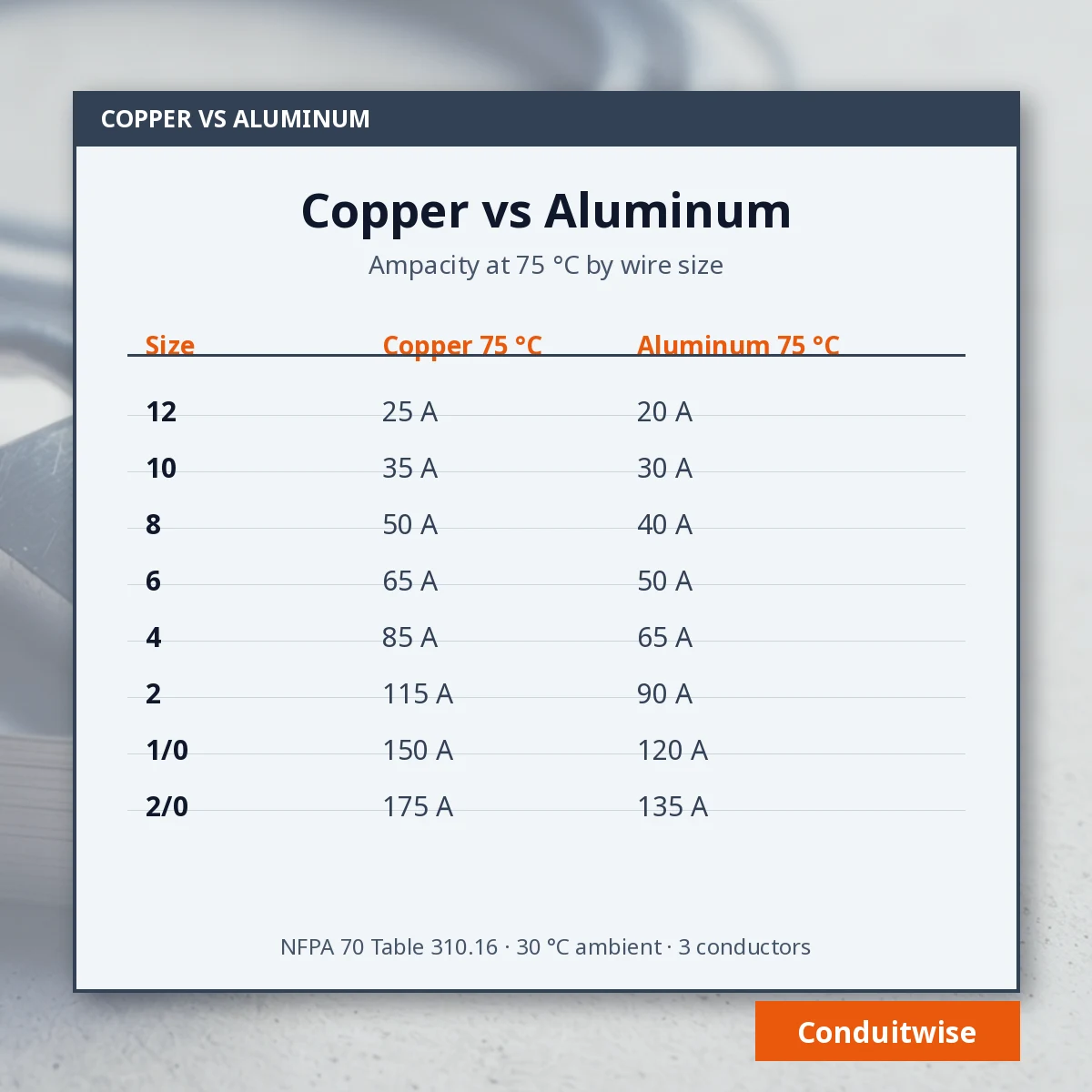
Aluminum conducts less current than copper of the same size, so the table lists lower ampacities, for example 40 A for 8 AWG aluminum against 50 A for copper at 75 °C. Aluminum also needs terminals listed for it.
Do I use the 90 °C column to size the wire?
You may start from the 90 °C column to apply temperature and conductor-count corrections, but the final ampacity may not be higher than the value for the 60 °C or 75 °C terminals the wire connects to. The tool above applies that cap.
Wiring an audio amplifier instead? See the amplifier wire gauge chart, and for a size by voltage drop use the electrical gauge wire chart.
Did this tool pass inspection?
Mark it as passed, or send it back for rework with a note.
Logged. Thank you for the report.