Amplifier Wire Gauge Chart
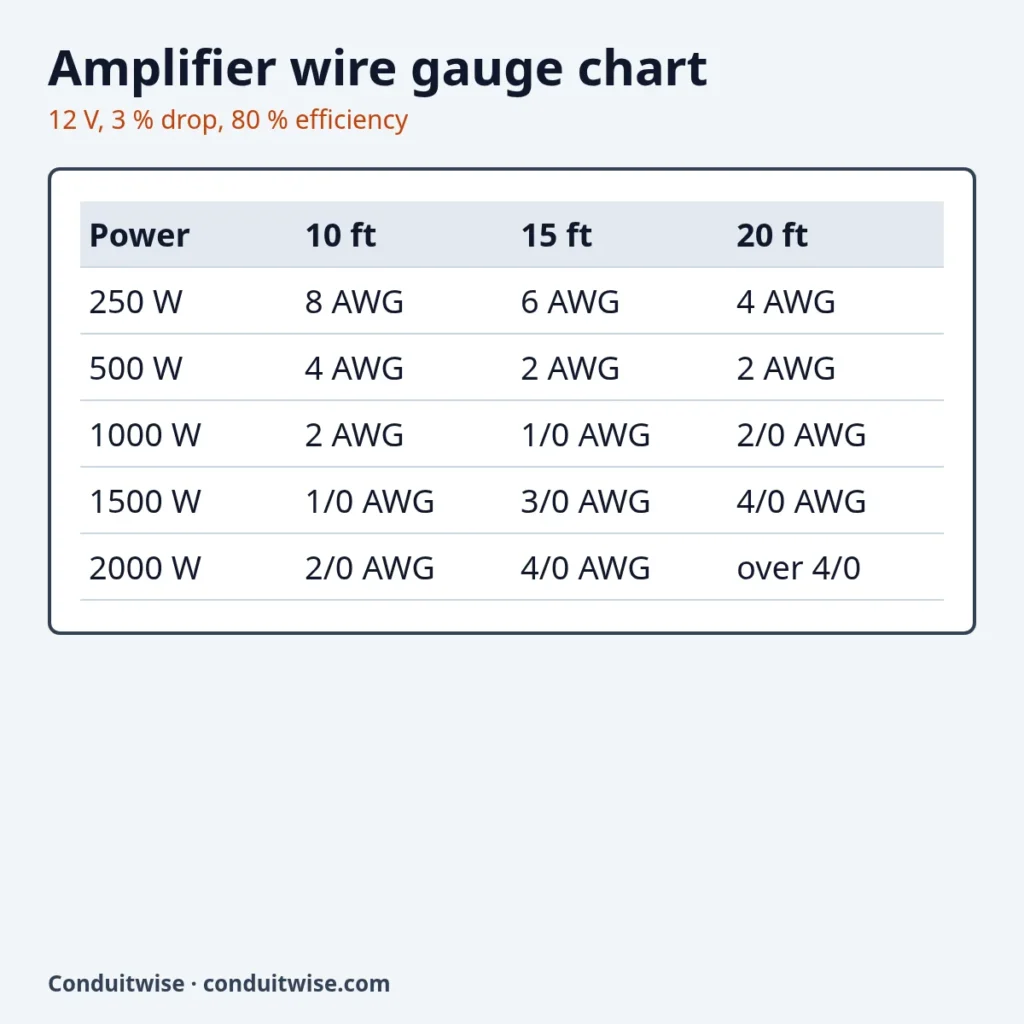
An amplifier wire gauge chart shows the power wire size a car amplifier needs so that the voltage at the amp stays close to the battery. Enter the amplifier power, the supply voltage, the run length and the drop you accept: a 1000 W amplifier on 12 V, 15 ft away, needs 1/0 AWG.
- Amplifier power
- 1000 W
- Efficiency used
- 80 %
- Supply
- 12 V
- Current drawn
- 104.2 A
- One-way run
- 15 ft
- Allowed voltage drop
- 3 % (0.36 V)
- Smallest AWG that fits
- 1/0 AWG
- Voltage drop at that size
- 0.31 V · 2.56 %
Current = power ÷ (voltage × efficiency). Voltage drop = 2 × length × current × ohm per 1000 ft ÷ 1000, copper at 20 °C. Follow your amplifier’s own wire and fuse instructions.
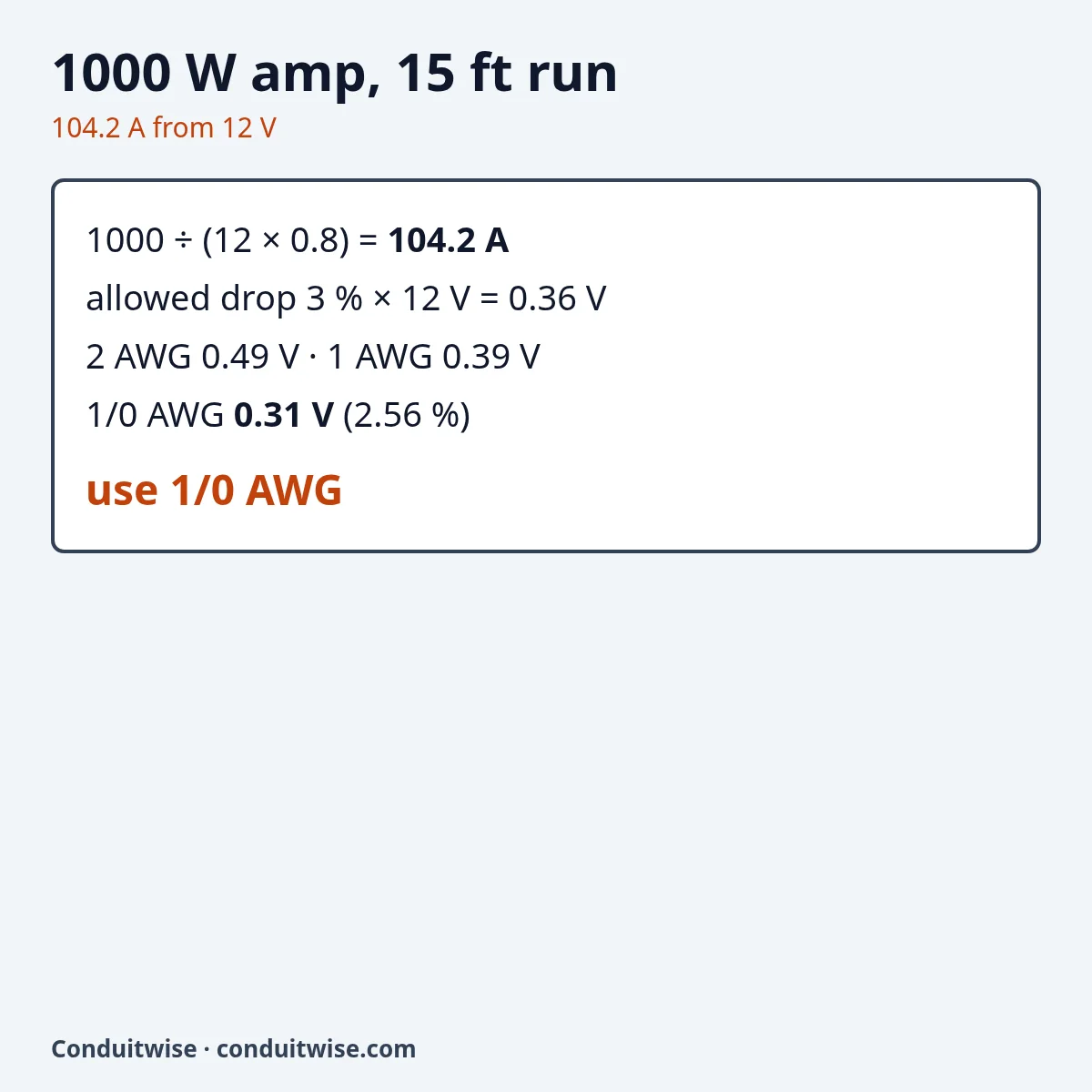
Worked example: a 1000 W amplifier, 15 ft
At 80 percent efficiency a 1000 W amplifier draws 1000 ÷ (12 × 0.8) = 104.2 A from a 12 V supply. A 3 percent drop at 12 V is 0.36 V. The run is out and back, 2 × 15 = 30 ft. 2 AWG at 0.1562 ohm per 1000 ft drops 2 × 15 × 104.2 × 0.1562 ÷ 1000 = 0.49 V, too much. 1 AWG at 0.1239 ohm per 1000 ft drops 0.39 V, still above 0.36 V. 1/0 AWG at 0.0983 ohm per 1000 ft drops 0.31 V, which is 2.56 percent, so 1/0 AWG is the smallest that fits.
Amplifier wire gauge chart, 12 V, 3 percent drop
| Amplifier power | Current at 80 % | 10 ft run | 15 ft run | 20 ft run |
|---|---|---|---|---|
| 250 W | 26.0 A | 8 AWG | 6 AWG | 4 AWG |
| 500 W | 52.1 A | 4 AWG | 2 AWG | 2 AWG |
| 1000 W | 104.2 A | 2 AWG | 1/0 AWG | 2/0 AWG |
| 1500 W | 156.2 A | 1/0 AWG | 3/0 AWG | 4/0 AWG |
| 2000 W | 208.3 A | 2/0 AWG | 4/0 AWG | thicker than 4/0 |
The chart assumes 80 percent efficiency, which is typical of a class D design; use the tool for your amplifier’s own figure.
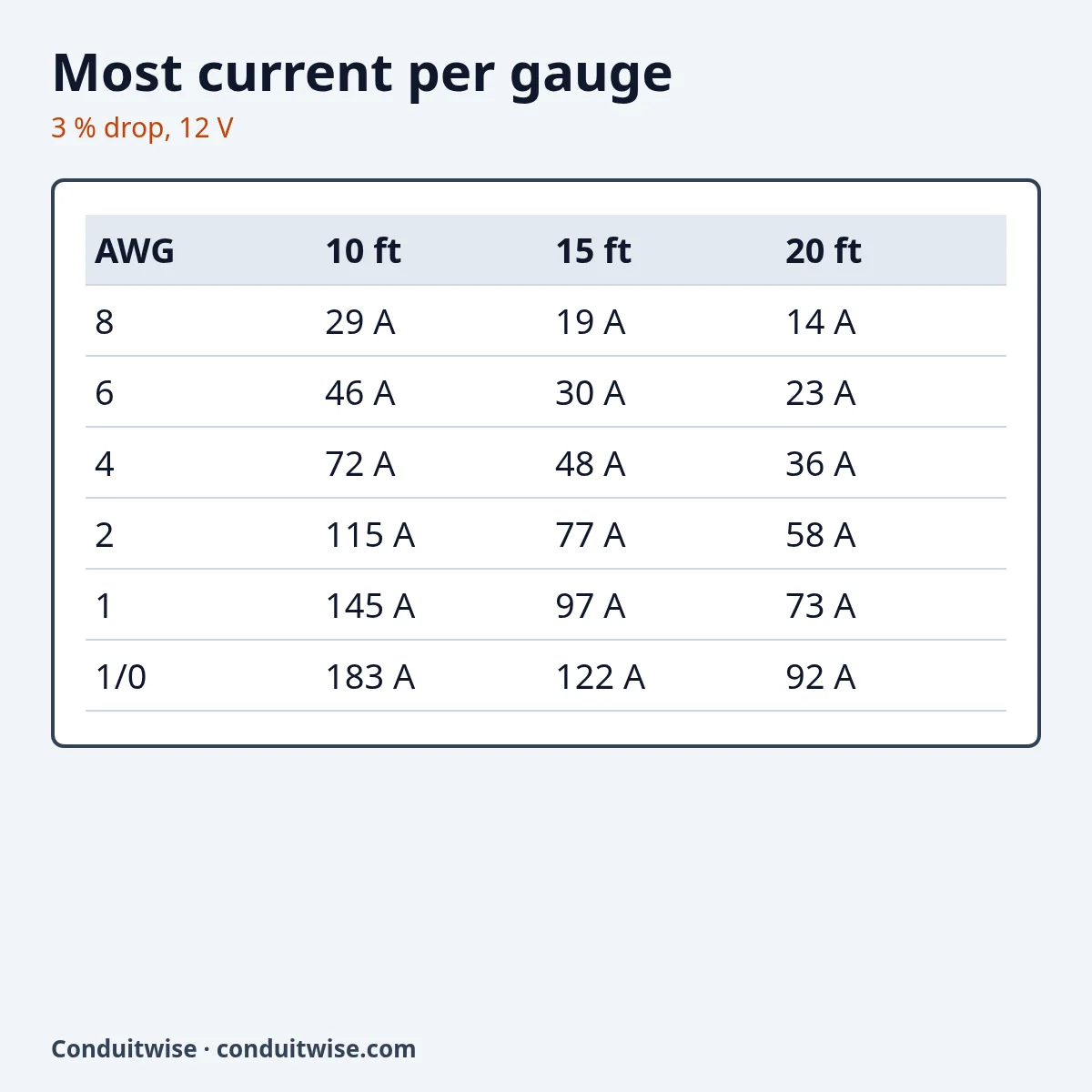
Most current each gauge can carry
| AWG | Ohm per 1000 ft | Most current, 10 ft run (A) | Most current, 15 ft run (A) | Most current, 20 ft run (A) |
|---|---|---|---|---|
| 8 | 0.628 | 28.7 | 19.1 | 14.3 |
| 6 | 0.395 | 45.6 | 30.4 | 22.8 |
| 4 | 0.248 | 72.5 | 48.3 | 36.2 |
| 2 | 0.156 | 115.2 | 76.8 | 57.6 |
| 1 | 0.124 | 145.3 | 96.8 | 72.6 |
| 1/0 | 0.098 | 183.2 | 122.1 | 91.6 |
| 2/0 | 0.078 | 231.0 | 154.0 | 115.5 |
| 3/0 | 0.062 | 291.3 | 194.2 | 145.6 |
Limits
The chart counts only the voltage drop in copper wire at 20 °C, not heat, fusing or terminal losses. Use the fuse and wire sizes in your amplifier’s manual and fit the fuse close to the battery. See the disclaimer.
How we checked it
On 22 October 2026 we compared the page’s calculation with a separate Python calculation on 250 random cases: no differences. The ohm per 1000 ft values agree with the published values for 4/0, 10, 12, 14, 18, 22, 30 and 40 AWG.
Frequently asked questions
What gauge wire do I need for a 1000 watt amplifier?
At 80 percent efficiency a 1000 W amp draws 104.2 A from 12 V. For a 15 ft run and a 3 percent voltage drop that is 1/0 AWG copper; a 10 ft run needs 2 AWG.
How is amp current calculated?
Current = power ÷ (voltage × efficiency). For 1000 W at 12 V and 80 percent that is 1000 ÷ (12 × 0.8) = 104.2 A.
Does the ground wire need to be the same size?
Use the same gauge for the ground as for the power wire and keep it short; the voltage drop counts both wires in the run.
Is copper-clad aluminum wire the same?
No. It has more resistance than copper, so this chart does not apply to it. Check the wire maker’s data.
For speaker cable see the speaker wire gauge chart, and for house wiring the electrical gauge wire chart.
Did this tool pass inspection?
Mark it as passed, or send it back for rework with a note.
Logged. Thank you for the report.