Tap Size Drill Bit Chart
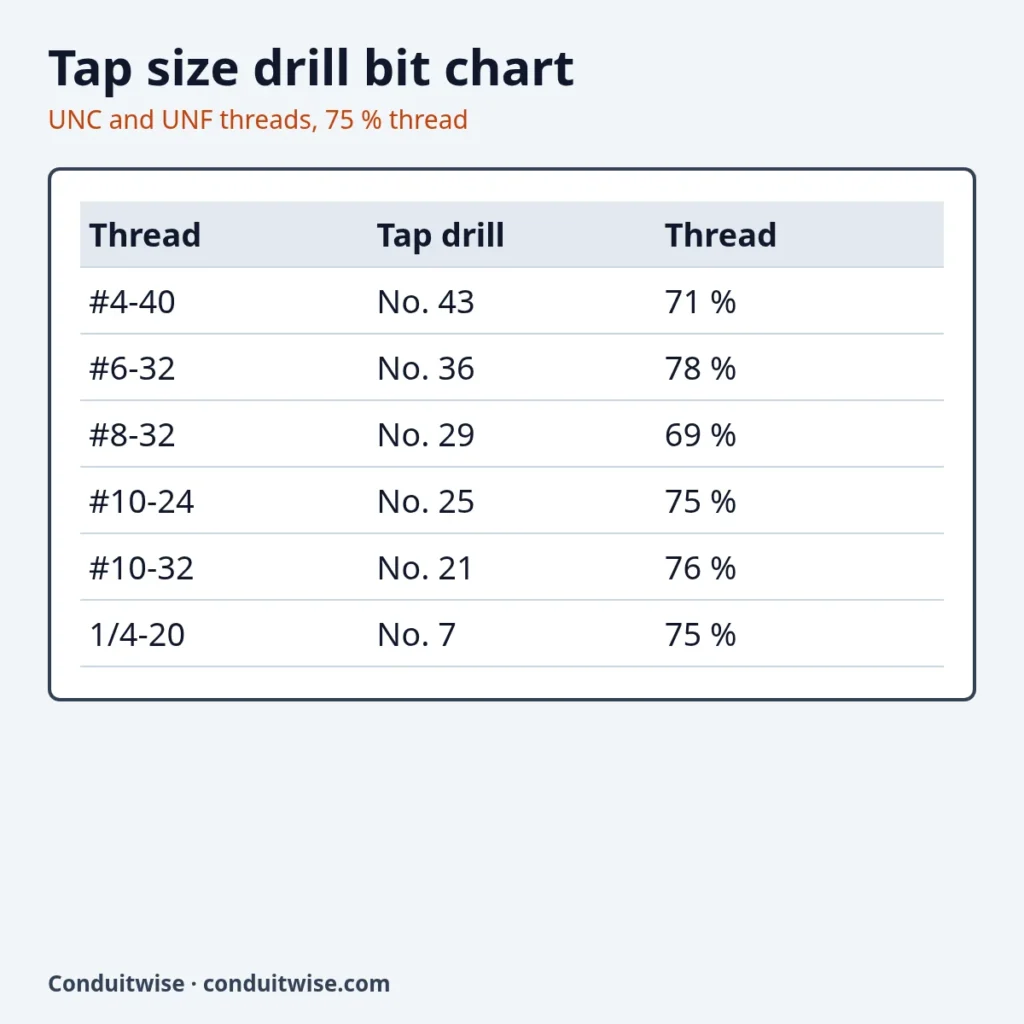
A tap size drill bit chart tells you which drill bit to use before you cut a thread with a tap. For each UNC and UNF thread from #0-80 to 1-12 it lists the major diameter and the nearest drill for a 75 percent thread, so a 1/4-20 tap takes a No. 7 drill.
- Thread
- 1/4-20 UNC
- Major diameter
- 0.2500 in · 6.35 mm
- Threads per inch
- 20
- Target tap drill (75% thread)
- 0.2013 in
- Nearest standard drill
- No. 7 · 0.2010 in
- Thread it gives
- 75 %
- Next smaller drill
- No. 8 · 0.1990 in · 79 %
- Next larger drill
- 13/64 in · 0.2031 in · 72 %
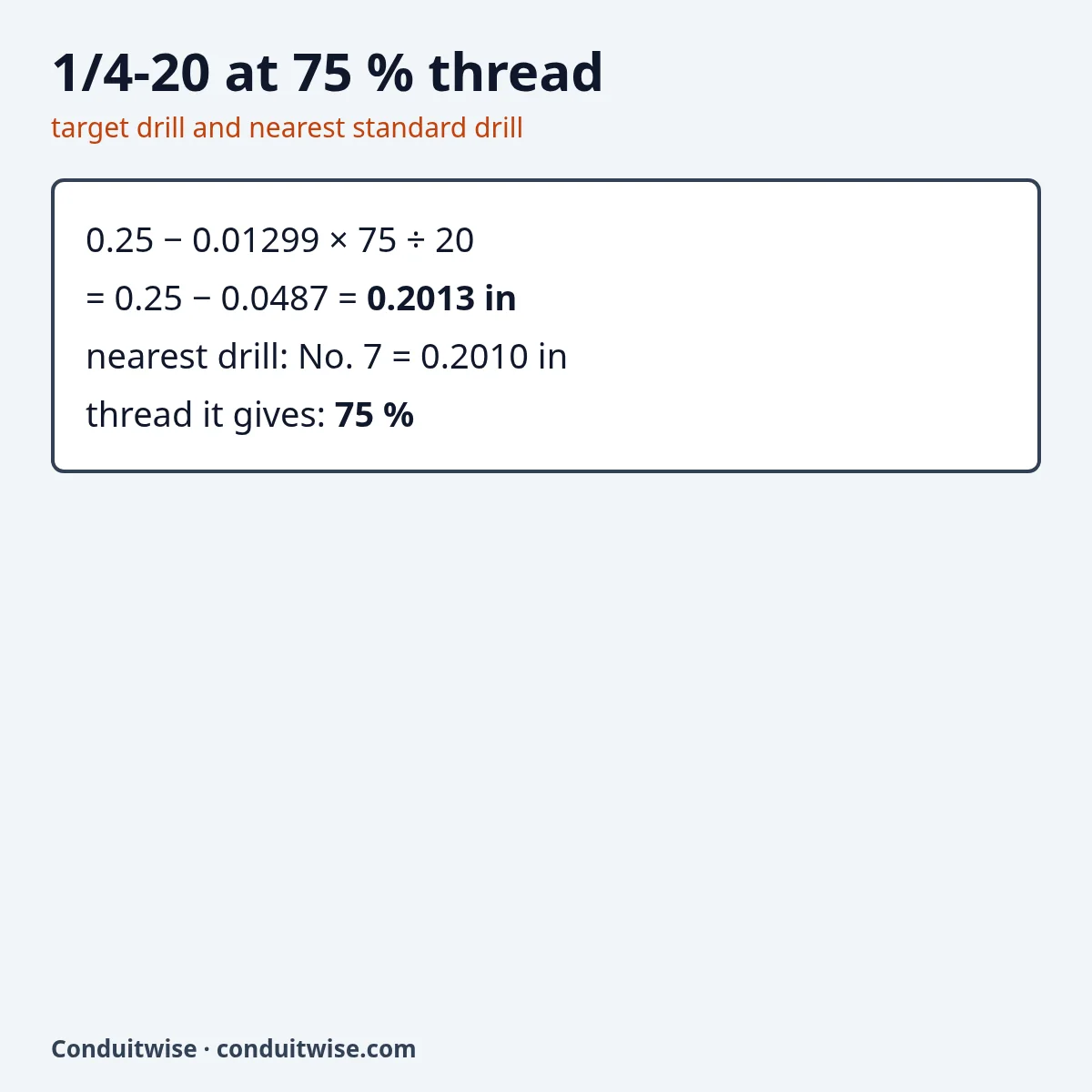
Tap drill = major diameter − 0.01299 × percent thread ÷ threads per inch. Percent thread = (major − drill) × TPI ÷ 0.01299.
Worked example: a 1/4-20 tap
A 1/4-20 thread has a major diameter of 0.25 in and 20 threads per inch. For a 75 percent thread the tap drill is 0.25 − 0.01299 × 75 ÷ 20 = 0.25 − 0.04871 = 0.2013 in. The nearest standard drill is No. 7 at 0.2010 in, and it gives (0.25 − 0.2010) × 20 ÷ 0.01299 = 75.4 percent, shown as 75 percent. The next smaller drill, No. 8 at 0.1990 in, gives a 79 percent thread, and the next larger, 13/64 in at 0.2031 in, gives a 72 percent thread.
Tap drill size chart, UNC and UNF
| Thread | Major (in) | TPI | 75 % target (in) | Nearest drill | Drill (in) | Thread it gives |
|---|---|---|---|---|---|---|
| #0-80 UNF | 0.0600 | 80 | 0.0478 | 3/64 in | 0.0469 | 81 % |
| #1-64 UNC | 0.0730 | 64 | 0.0578 | No. 53 | 0.0595 | 67 % |
| #1-72 UNF | 0.0730 | 72 | 0.0595 | No. 53 | 0.0595 | 75 % |
| #2-56 UNC | 0.0860 | 56 | 0.0686 | No. 50 | 0.0700 | 69 % |
| #2-64 UNF | 0.0860 | 64 | 0.0708 | No. 50 | 0.0700 | 79 % |
| #3-48 UNC | 0.0990 | 48 | 0.0787 | No. 47 | 0.0785 | 76 % |
| #3-56 UNF | 0.0990 | 56 | 0.0816 | No. 45 | 0.0820 | 73 % |
| #4-40 UNC | 0.1120 | 40 | 0.0876 | No. 43 | 0.0890 | 71 % |
| #4-48 UNF | 0.1120 | 48 | 0.0917 | No. 42 | 0.0935 | 68 % |
| #5-40 UNC | 0.1250 | 40 | 0.1006 | No. 38 | 0.1015 | 72 % |
| #5-44 UNF | 0.1250 | 44 | 0.1029 | No. 37 | 0.1040 | 71 % |
| #6-32 UNC | 0.1380 | 32 | 0.1076 | No. 36 | 0.1065 | 78 % |
| #6-40 UNF | 0.1380 | 40 | 0.1136 | No. 33 | 0.1130 | 77 % |
| #8-32 UNC | 0.1640 | 32 | 0.1336 | No. 29 | 0.1360 | 69 % |
| #8-36 UNF | 0.1640 | 36 | 0.1369 | No. 29 | 0.1360 | 78 % |
| #10-24 UNC | 0.1900 | 24 | 0.1494 | No. 25 | 0.1495 | 75 % |
| #10-32 UNF | 0.1900 | 32 | 0.1596 | No. 21 | 0.1590 | 76 % |
| #12-24 UNC | 0.2160 | 24 | 0.1754 | No. 16 | 0.1770 | 72 % |
| #12-28 UNF | 0.2160 | 28 | 0.1812 | No. 14 | 0.1820 | 73 % |
| 1/4-20 UNC | 0.2500 | 20 | 0.2013 | No. 7 | 0.2010 | 75 % |
| 1/4-28 UNF | 0.2500 | 28 | 0.2152 | No. 3 | 0.2130 | 80 % |
| 5/16-18 UNC | 0.3125 | 18 | 0.2584 | Letter F | 0.2570 | 77 % |
| 5/16-24 UNF | 0.3125 | 24 | 0.2719 | Letter I | 0.2720 | 75 % |
| 3/8-16 UNC | 0.3750 | 16 | 0.3141 | 5/16 in | 0.3125 | 77 % |
| 3/8-24 UNF | 0.3750 | 24 | 0.3344 | Letter Q | 0.3320 | 79 % |
| 7/16-14 UNC | 0.4375 | 14 | 0.3679 | Letter U | 0.3680 | 75 % |
| 7/16-20 UNF | 0.4375 | 20 | 0.3888 | 25/64 in | 0.3906 | 72 % |
| 1/2-13 UNC | 0.5000 | 13 | 0.4251 | 27/64 in | 0.4219 | 78 % |
| 1/2-20 UNF | 0.5000 | 20 | 0.4513 | 29/64 in | 0.4531 | 72 % |
| 9/16-12 UNC | 0.5625 | 12 | 0.4813 | 31/64 in | 0.4844 | 72 % |
| 9/16-18 UNF | 0.5625 | 18 | 0.5084 | 33/64 in | 0.5156 | 65 % |
| 5/8-11 UNC | 0.6250 | 11 | 0.5364 | 17/32 in | 0.5313 | 79 % |
| 5/8-18 UNF | 0.6250 | 18 | 0.5709 | 37/64 in | 0.5781 | 65 % |
| 3/4-10 UNC | 0.7500 | 10 | 0.6526 | 21/32 in | 0.6563 | 72 % |
| 3/4-16 UNF | 0.7500 | 16 | 0.6891 | 11/16 in | 0.6875 | 77 % |
| 7/8-9 UNC | 0.8750 | 9 | 0.7668 | 49/64 in | 0.7656 | 76 % |
| 7/8-14 UNF | 0.8750 | 14 | 0.8054 | 13/16 in | 0.8125 | 67 % |
| 1-8 UNC | 1.0000 | 8 | 0.8782 | 7/8 in | 0.8750 | 77 % |
| 1-12 UNF | 1.0000 | 12 | 0.9188 | 59/64 in | 0.9219 | 72 % |
Each row uses the nearest drill from the fractional, number and letter sets, for a 75 percent thread. Published charts sometimes show a neighboring drill. For metric threads use the metric drill bit size chart.
Choosing a thread depth
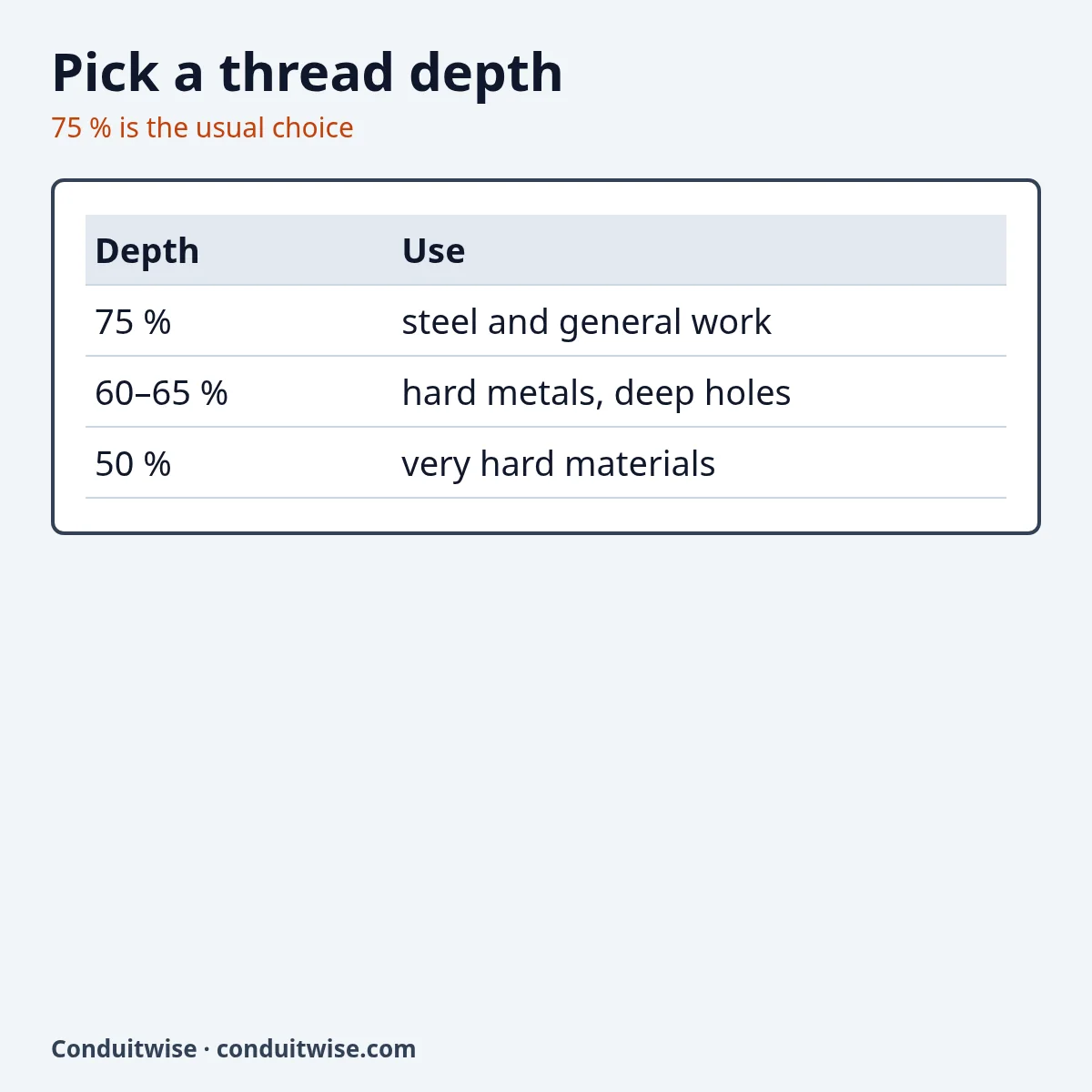
- 75 percent: the usual choice for steel and general work.
- 60 to 65 percent: easier tapping in hard metals and for deep holes, with little loss of strength.
- 50 percent: only for very hard materials or when a tap might break.
Limits
The chart is for a standard 60 degree unified thread tapped by cutting. A forming tap needs a larger drill, so follow the tap maker’s chart for that. Drill sizes come from the number, letter and fractional series as published in drill charts. See the disclaimer.
How we checked it
On 22 October 2026 we compared the page’s calculation with a separate Python calculation on 250 random cases: no differences. The thread formulas are the ones printed above, and we also checked the nearest-drill choice for all 39 threads against the 75 percent target.
Frequently asked questions
What size drill bit do I use for a 1/4-20 tap?
A No. 7 drill, 0.2010 in. The 75 percent target is 0.2013 in, and a No. 7 drill gives a 75 percent thread.
How is a tap drill size calculated?
Tap drill = major diameter − 0.01299 × percent thread ÷ threads per inch. For 1/4-20 at 75 percent that is 0.25 − 0.01299 × 75 ÷ 20 = 0.2013 in.
Why do other charts show a different drill?
Charts round to different drills and some aim for a different thread depth. A drill one size smaller gives a deeper thread and takes more force to tap.
Is a 100 percent thread stronger?
Not much. Extra thread depth adds little strength and makes the tap much harder to turn, so 60 to 75 percent is common.
See also the drill bit size chart, the number drill bit size chart and the drill bit hole size chart.
Did this tool pass inspection?
Mark it as passed, or send it back for rework with a note.
Logged. Thank you for the report.