Speaker Wire Gauge Chart
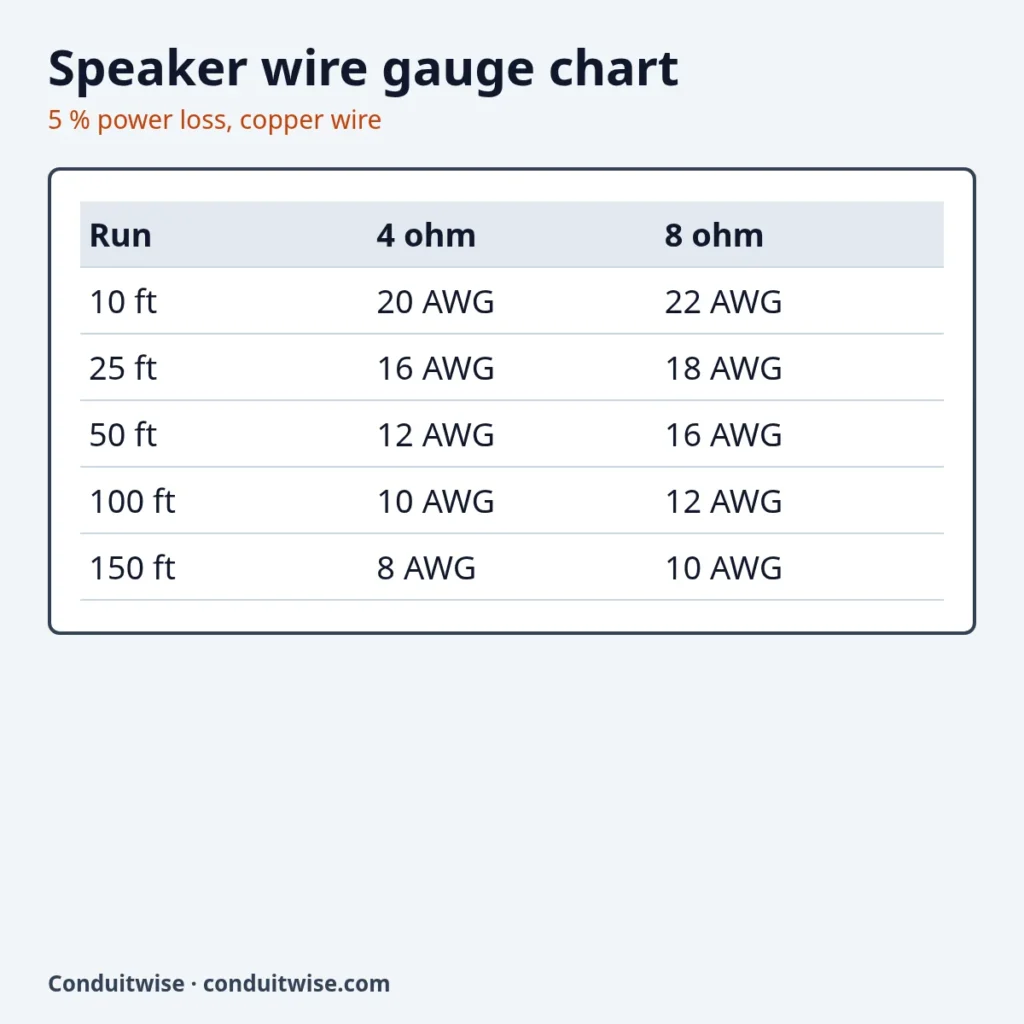
A speaker wire gauge chart shows how thick the wire must be so little power is lost on the way to the speaker. Enter the speaker impedance, the run length and the loss you accept to get the smallest AWG: 16 AWG for an 8 ohm speaker 50 ft away at 5 percent.
- Speaker
- 8 ohm
- One-way run
- 50 ft (100 ft of wire)
- Allowed power loss
- 5 %
- Smallest AWG that fits
- 16 AWG
- Power lost in the wire
- 4.78 %
- Wire resistance (out and back)
- 0.402 ohm
Power lost in the wire = wire resistance ÷ (wire resistance + speaker impedance). Resistance of copper at 20 °C; speaker impedance is treated as a plain resistance.
| AWG | Ohm per 1000 ft | Wire resistance | Power lost |
|---|---|---|---|
| 4 | 0.248 | 0.025 ohm | 0.31 % |
| 6 | 0.395 | 0.040 ohm | 0.49 % |
| 8 | 0.628 | 0.063 ohm | 0.78 % |
| 10 | 0.999 | 0.100 ohm | 1.23 % |
| 12 | 1.588 | 0.159 ohm | 1.95 % |
| 14 | 2.525 | 0.253 ohm | 3.06 % |
| 16 | 4.015 | 0.402 ohm | 4.78 % |
| 18 | 6.385 | 0.638 ohm | 7.39 % |
| 20 | 10.152 | 1.015 ohm | 11.26 % |
| 22 | 16.142 | 1.614 ohm | 16.79 % |
| 24 | 25.667 | 2.567 ohm | 24.29 % |
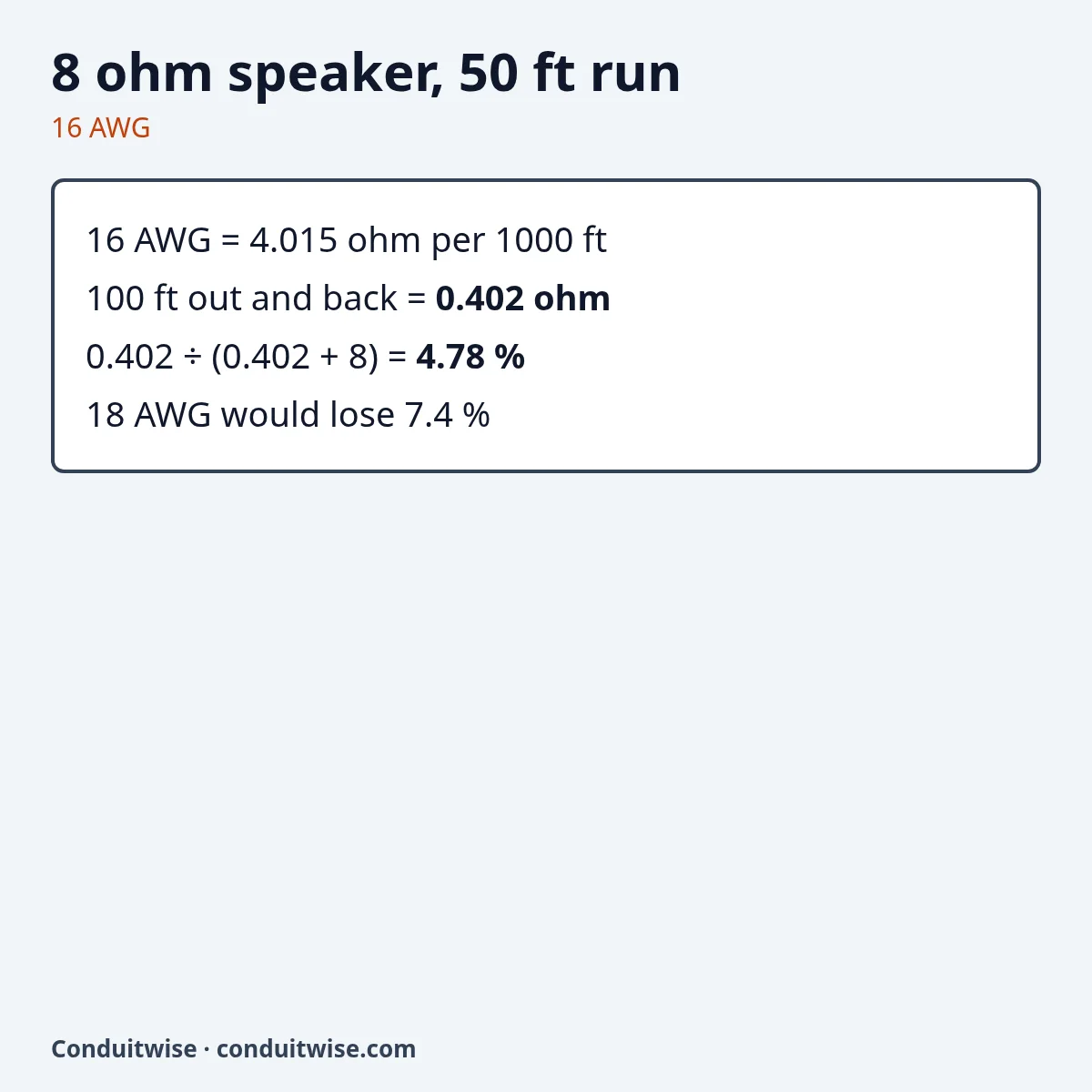
Worked example: 8 ohm speaker, 50 ft run
16 AWG copper is 4.015 ohm per 1000 ft. Out and back is 2 × 50 = 100 ft of wire, so the wire resistance is 4.015 × 100 ÷ 1000 = 0.402 ohm. The power lost is 0.402 ÷ (0.402 + 8) = 4.78 percent, under the 5 percent limit. A thinner 18 AWG wire has 6.385 ohm per 1000 ft, 0.639 ohm for the run and a loss of 7.4 percent.
Speaker wire gauge chart at 5 percent loss
| One-way run | 4 ohm speaker | 8 ohm speaker |
|---|---|---|
| 10 ft | 20 AWG (4.8 %) | 22 AWG (3.9 %) |
| 25 ft | 16 AWG (4.8 %) | 18 AWG (3.8 %) |
| 50 ft | 12 AWG (3.8 %) | 16 AWG (4.8 %) |
| 75 ft | 10 AWG (3.6 %) | 14 AWG (4.5 %) |
| 100 ft | 10 AWG (4.8 %) | 12 AWG (3.8 %) |
| 150 ft | 8 AWG (4.5 %) | 10 AWG (3.6 %) |
The number in brackets is the loss for the gauge shown. Choose a lower loss limit in the tool above for a stricter result.
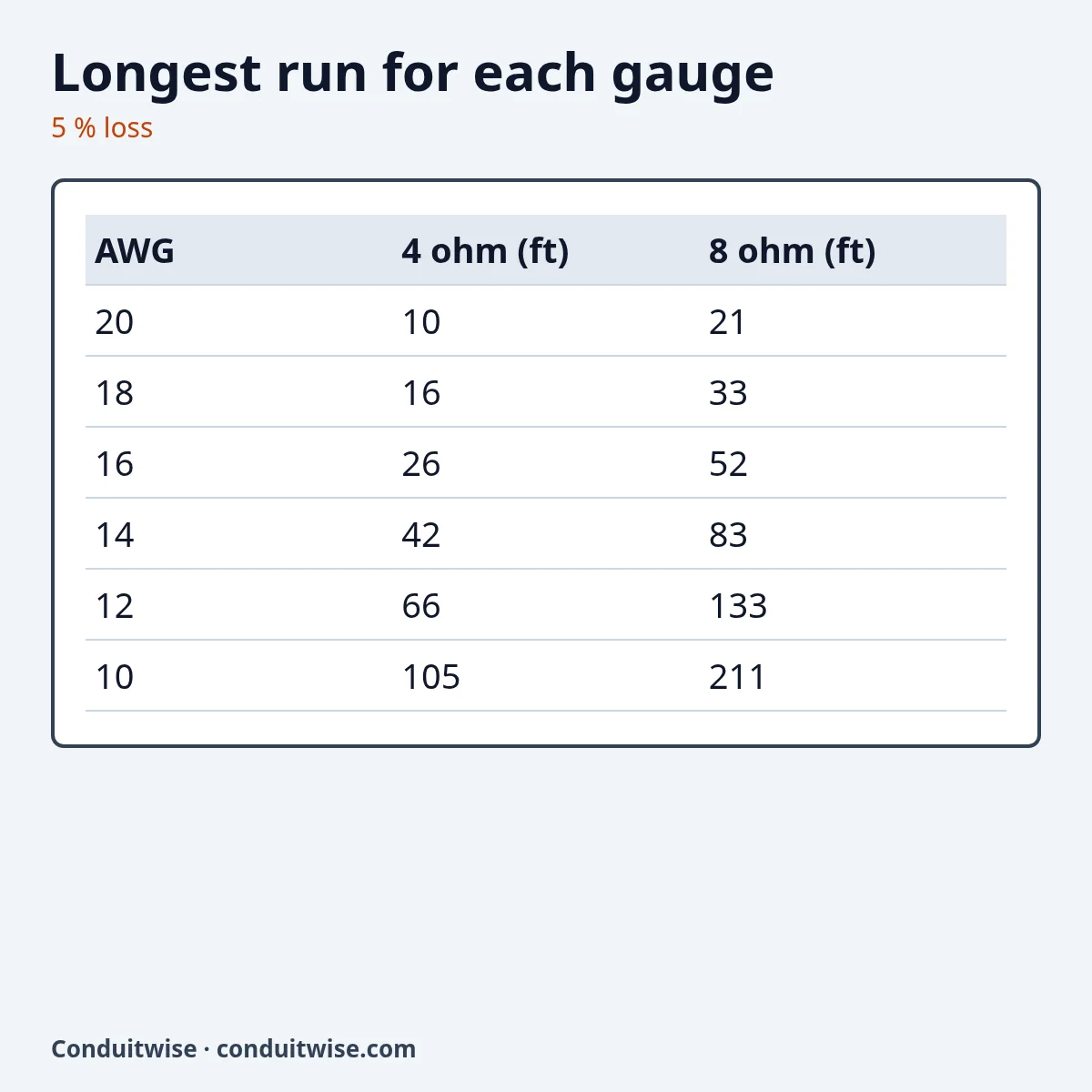
Longest run for each gauge
| AWG | Ohm per 1000 ft | Longest run, 4 ohm (ft) | Longest run, 8 ohm (ft) |
|---|---|---|---|
| 20 | 10.152 | 10 | 21 |
| 18 | 6.385 | 16 | 33 |
| 16 | 4.015 | 26 | 52 |
| 14 | 2.525 | 42 | 83 |
| 12 | 1.588 | 66 | 133 |
| 10 | 0.999 | 105 | 211 |
Copper wire resistance by gauge
| AWG | Diameter (mm) | Area (mm²) | Ohm per 1000 ft |
|---|---|---|---|
| 24 | 0.511 | 0.20 | 25.667 |
| 22 | 0.644 | 0.33 | 16.142 |
| 20 | 0.812 | 0.52 | 10.152 |
| 18 | 1.024 | 0.82 | 6.385 |
| 16 | 1.291 | 1.31 | 4.015 |
| 14 | 1.628 | 2.08 | 2.525 |
| 12 | 2.053 | 3.31 | 1.588 |
| 10 | 2.588 | 5.26 | 0.999 |
| 8 | 3.264 | 8.37 | 0.628 |
Limits
The chart treats the speaker as a plain resistance equal to its rated impedance, which is a simplification: real speakers change impedance with frequency. It uses copper wire at 20 °C. Wire made of copper-clad aluminum has more resistance, so check the maker’s data. Resistance values follow the AWG diameter formula and 1.724 µΩ·cm for annealed copper. See the disclaimer.
How we checked it
On 22 October 2026 we compared the page’s calculation with a separate Python calculation on 250 random cases: no differences. The AWG diameters and resistances agree with the published values for 4/0, 10, 12, 14, 18, 22, 30 and 40 AWG.
Frequently asked questions
What gauge speaker wire do I need?
It depends on the run and the speaker. For an 8 ohm speaker 50 ft from the amplifier, 16 AWG loses 4.78 percent of the power. A longer run or a 4 ohm speaker needs a thicker wire.
How is power loss in speaker wire calculated?
Add the wire’s resistance out and back, then divide it by the wire plus the speaker: loss = Rwire ÷ (Rwire + Zspeaker). For 16 AWG over 50 ft that is 0.402 ÷ (0.402 + 8) = 4.78 percent.
Does a thicker wire sound better?
A thicker wire loses less power and changes the level less. It does not change the sound beyond that, and the loss you accept is your choice.
Why does a 4 ohm speaker need thicker wire?
The wire’s resistance is a bigger share of a lower impedance, so the same wire loses more power with a 4 ohm speaker than with an 8 ohm one.
For amplifier power wire see the amplifier wire gauge chart, and for mains wiring the electrical gauge wire chart.
Did this tool pass inspection?
Mark it as passed, or send it back for rework with a note.
Logged. Thank you for the report.